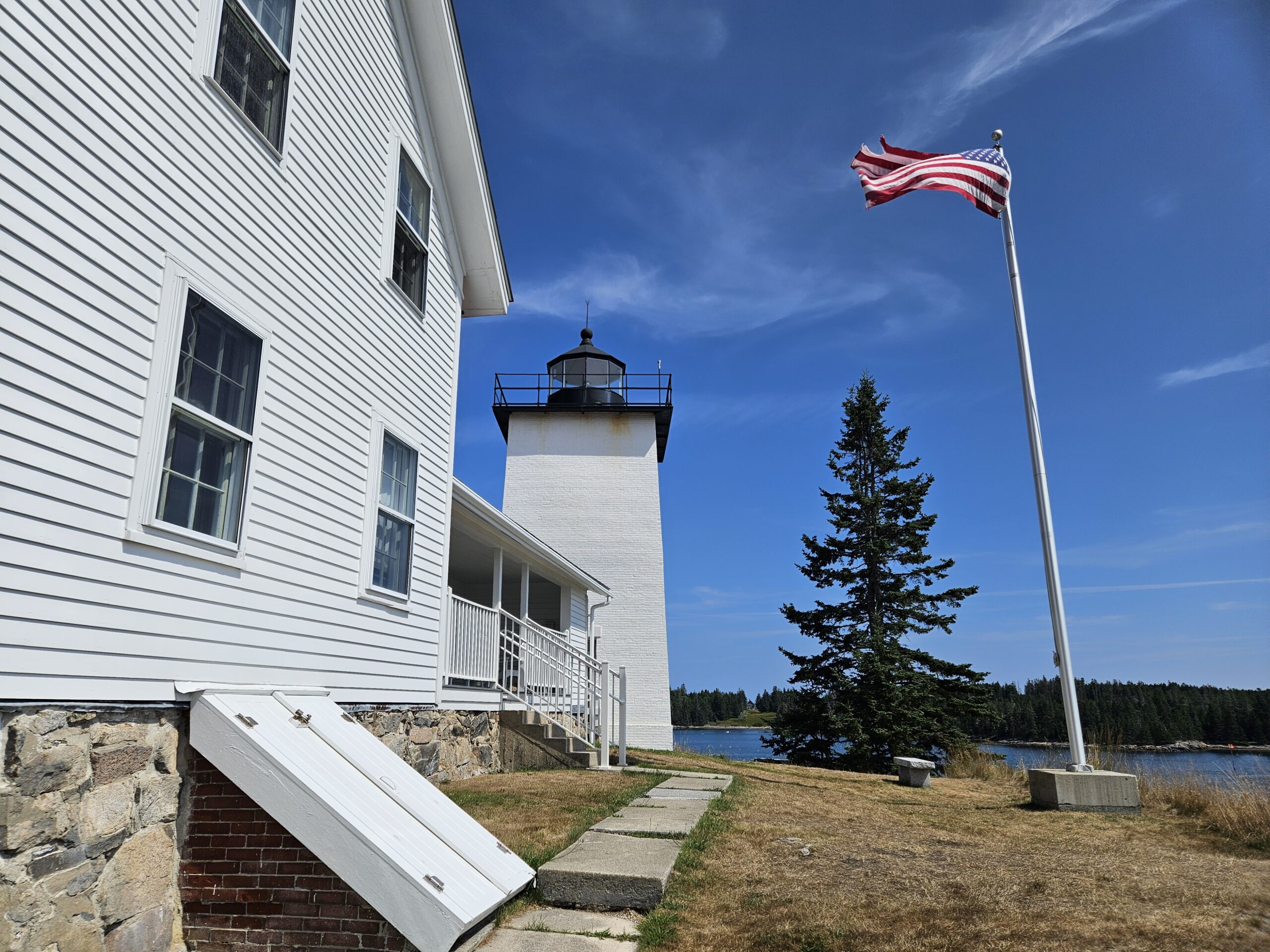
It is Sunday, July 19, and we are not in a hurry to leave Northeast Harbor. It makes a superb center from which to explore Mount Desert Island and Acadia. While there is no room for anchoring in the harbor itself, the moorings are reasonable, come with a launch and clean facilities, and the free Island Explorer bus picks up right by the harbormaster’s office! So, we opt to spend some time here.
First order of business is to track down a small freshwater leak – turns out one of the valves on the freshwater manifold drips every few seconds from the valve stem, so it needs to be repacked. We buy the packing, but will save the job for another day, as botching this could take down the entire fresh water system. While the task should be uninvolved, the impact of something going very wrong would be great. We decide we should also update our freshwater accumulator to one with a greater volume – our current one is about a pint, and Hamilton Marine (in Southwest Harbor) has a 1 liter one in-stock. More on this later.
Another big front is expected on Wednesday, with seas just offshore predicted to be 5 to 8ft and winds expected to gust 30kts. NE Harbor is a fine place to sit out a blow, so we plan to stay for a few days at least.
Carriage Trails to Bar Harbor
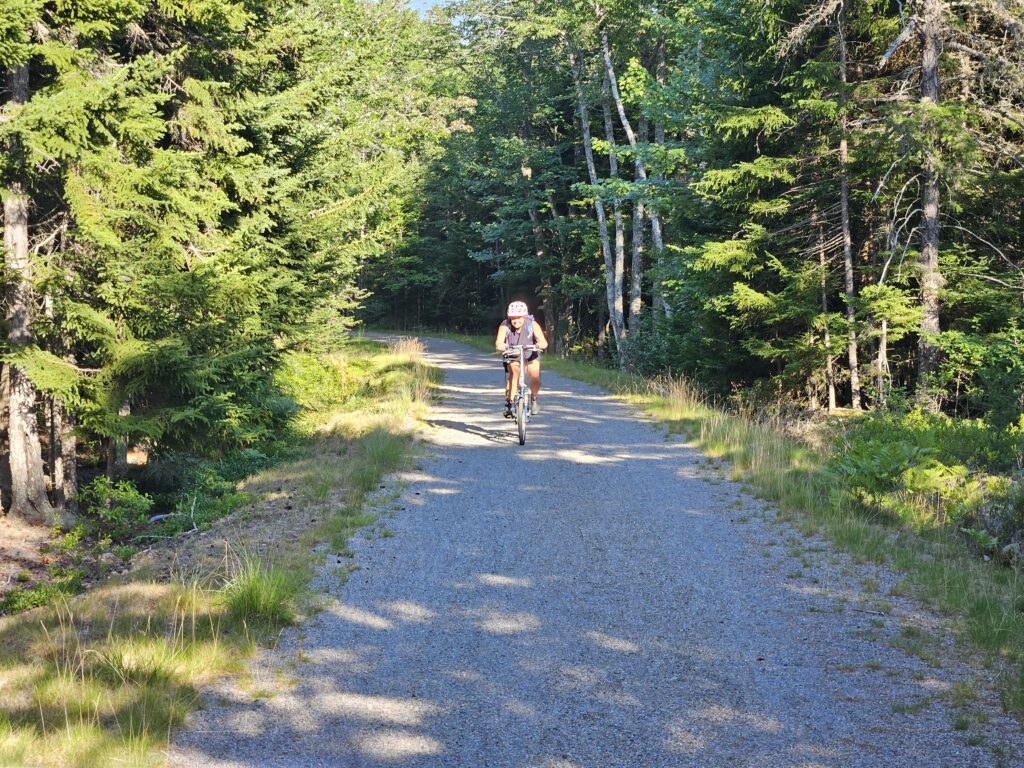
The Rockefellers wanted carriage trails (as in horse carriage trails) throughout the park. These were designed to be wide, accommodate a horse-drawn carriage, not be too steep, and so on. Today, these same trails make excellent offroad cycling trails and today we will ride some of those carriage trails on our folding bikes. First order of business is to determine whether the bike racks on the Island Explorer will accommodate the bikes. The busses can hold 6 bikes each – 3 in front, 3 in the rear. Since our bikes have 20″ wheels, we find the bus parked by the harbormaster’s office and simply put the bikes in the carrier. They fit! Turns out, the carriers are designed for a minimum diameter of 20 inches. We don’t ride the bus yet – the intent here is to ensure we could utilize the bus for the RETURN trip. So, we remove the bikes again. The bus driver is puzzled at first, but is fine after we explain our intentions.
We ride the bikes along route 3 up to Brown Mountain Gatehouse, which is the nearest access to the carriage road. Our destination is Bar Harbor and we ride the following to get there: Brown Mountain connector -> Hadlock Loop -> across Hemlock Bridge -> Upper Mountain trail -> Eagle Lake connector -> Eagle Lake trail -> Witch Hole connector -> Witch Hole trail -> Duck Brook road -> Bar Harbor. All in all, 15 miles, with beautiful vistas, and fields of ripe blueberries (near Chasm Brook Bridge, north of Sargent Peak) – yes, of course we stop to snack! Most of the climbing (about 1,000 feet overall) is within the first 5 miles. But it’s not steep – about 4-5% grade – again, the Rockefellers didn’t want to work their horses too hard. From Eagle Lake onward, it’s mostly downhill.
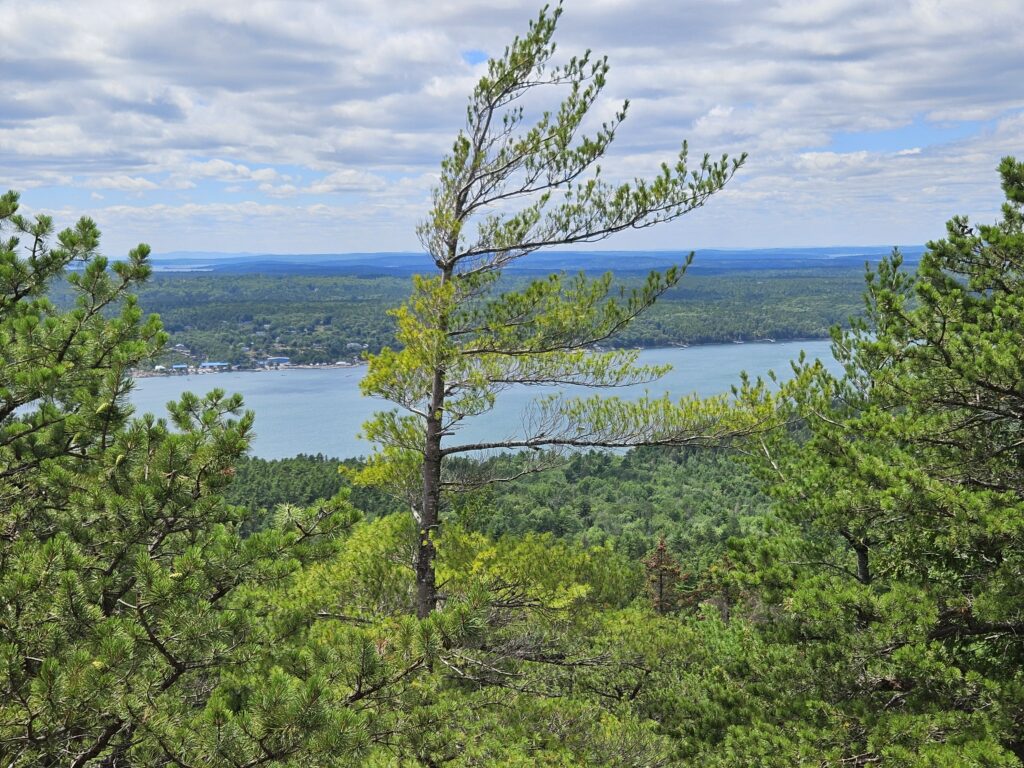
We arrive in Bar Harbor and have a very late lunch as Stewman’s, which is right on the water, overlooking the harbor. They have Blueberry Ale, which comes topped with fresh, wild, Maine blueberries!
It is blowing with spirit from the north today (20-26kts), and we note that the actual harbor at Bar Harbor is pretty choppy. It would be an unpleasant place to be in a small yacht during a northerly or easterly. For those winds, perhaps Seal’s Cove would offer more comfort. Our resolution: for a northeast wind of any strength, find someplace other than Bar Harbor.
After our late lunch, we do some window-shopping and then catch the last (17:15) bus #6 from Village Green back to Northeast Harbor.
The Bubbles and Jordan Pond
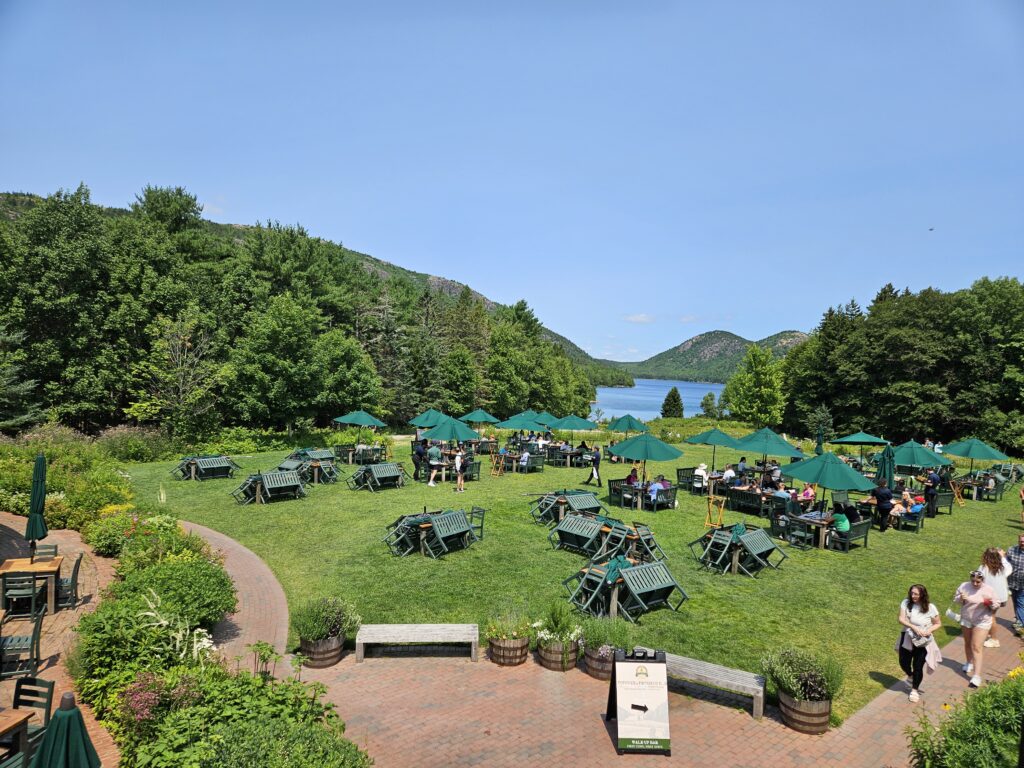
The next day, Monday, we opt to hike the Jordan Pond Loop and the Bubbles (both North and South). Back on the Island Explorer #6 we go to Jordan Pond House, situated at the southern end of what most of us would probably call a lake, and which looks really pleasant: it has a big green lawn with picnic tables and cheerful umbrellas, and with an unencumbered view of Jordan Pond.
But we’ll visit that after our hike. We stop in at the Grab-N-Go market to buy a sandwich, chips, and pickles for lunch (great decision!) and then set out to circumnavigate Jordan Pond clockwise. At the northern end of the lake, there’s a trail to climb the North Bubble; at the top, we have beautiful vistas of Jordan Pond and, beyond, the Cranberry Islands. We eat our sandwich and snacks here, seated on a rock overlooking Jordan Pond and the Cranberries. It’s hard to beat.
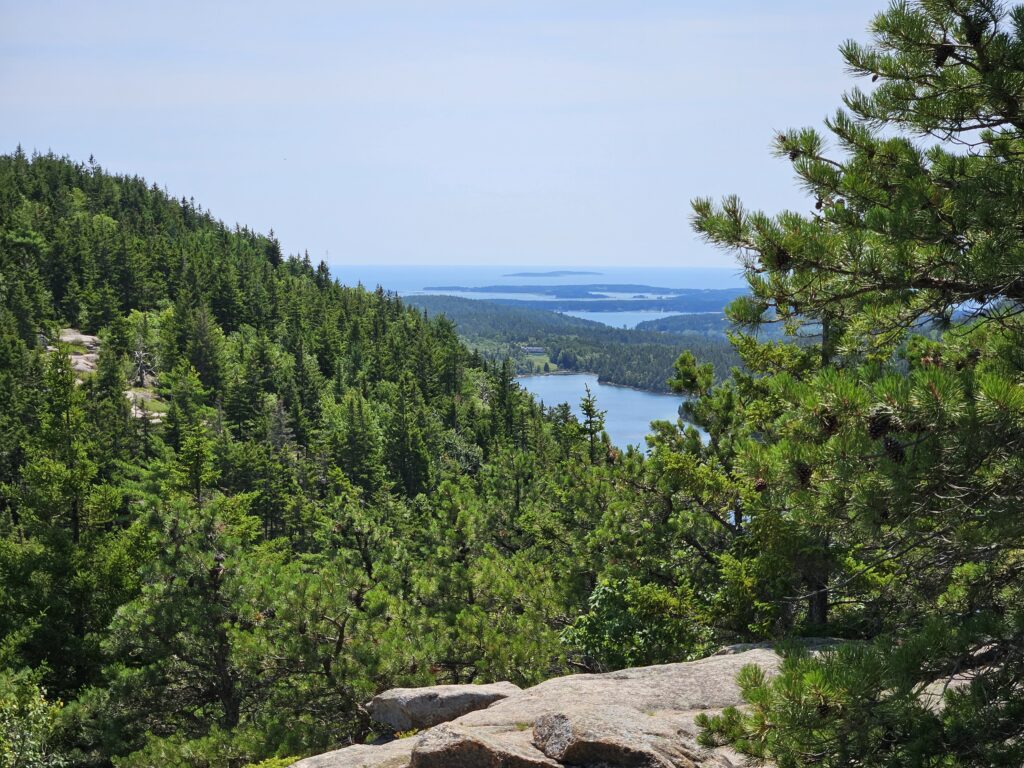
After lunch, we descend and climb South Bubble. This trail is much more populated with people. Perhaps this is because this is where “Bubble Rock”, the huge granite boulder, is precariously perched, or maybe it’s just ease of access. The climb up South Bubble from the north (which is the direction you’d take from the nearby car access point) is not hard. We opt to descend the south face of South Bubble, and that is a bit more of a job, requiring some scrambling, clinging to iron rungs, and a squeeze through “Fat Man’s Squeeze.” We manage this and are rewarded with some of the best views of the hike! All in all, about 4.5 miles of hiking for the day.
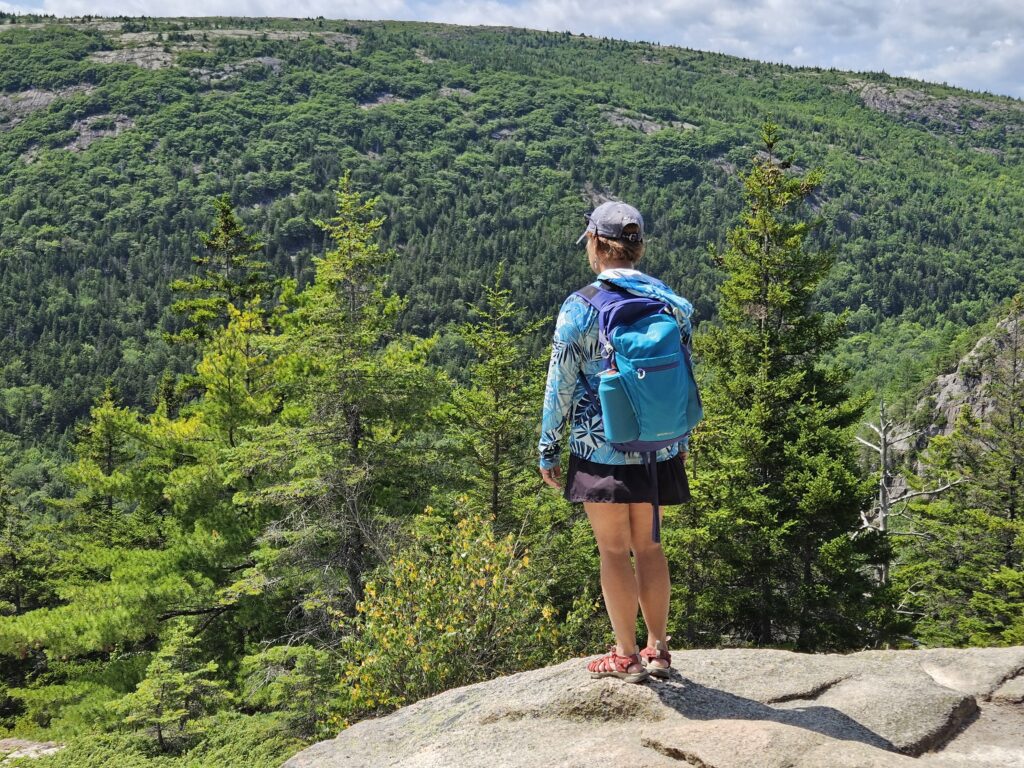
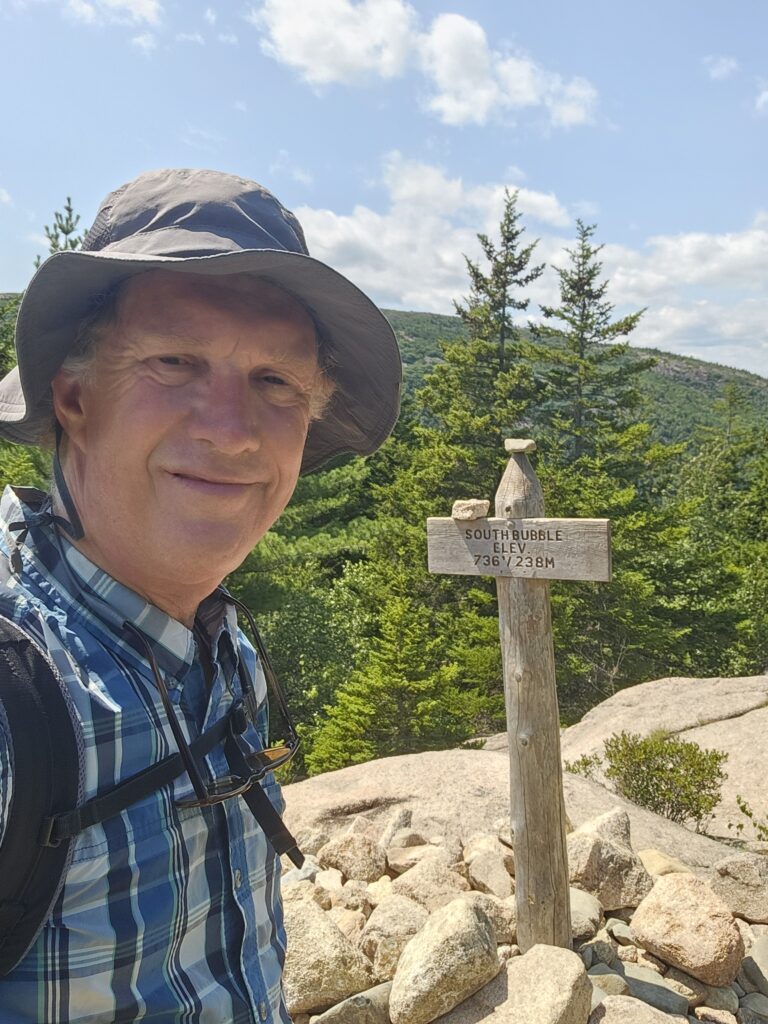
We return to Jordan Pond House with an appetite, and looking forward to the famous “pop-overs!” We get in the pop-over and prosecco line (which is separate from the restaurant line), but it is hardly moving. Meanwhile, to our dismay, the delightful picnic table umbrellas are being taken down in the lawn, and there’s a swarm of yellowjackets around the entire place. This is starting to resemble a Hitchcock thriller where the bees take over the world. In retrospect, for a pop-over in the lawn, it’s probably better to get there soon after the restaurant opens at 11a. The yellowjackets seem to be most drawn to the jam served with the pop-overs. Suddenly, perhaps after complaints of patrons being stung, an employee announces, “No more jam!” and that’s that. The pop-over line disintegrates as disappointed people shuffle off. But the stalwart crew of Canto quickly puts their name in for a restaurant seat. After about a 40 minute wait, we are seated and have a delicious early-dinner, plus hot pop-overs. With jam. Fortunately, the yellowjackets did not infiltrate the restaurant.
Asticou and Abby Aldrich Rockefeller Gardens
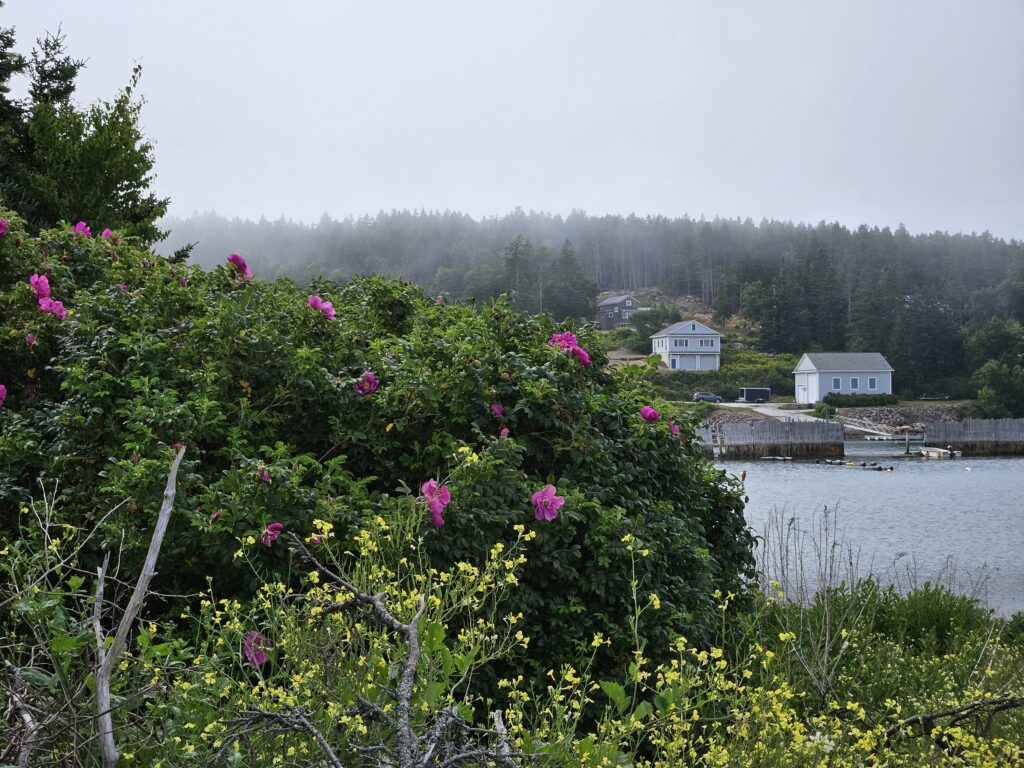
Northeast Harbor has easy access to several splendid gardens: Asticou, Thuya, Abby Aldrich Rockefeller, Acadia Wild Gardens – indeed, the entire area is, in the summer time, a big garden. Wild roses that would make a North Carolina gardener proud grow in large, verdant thickets.
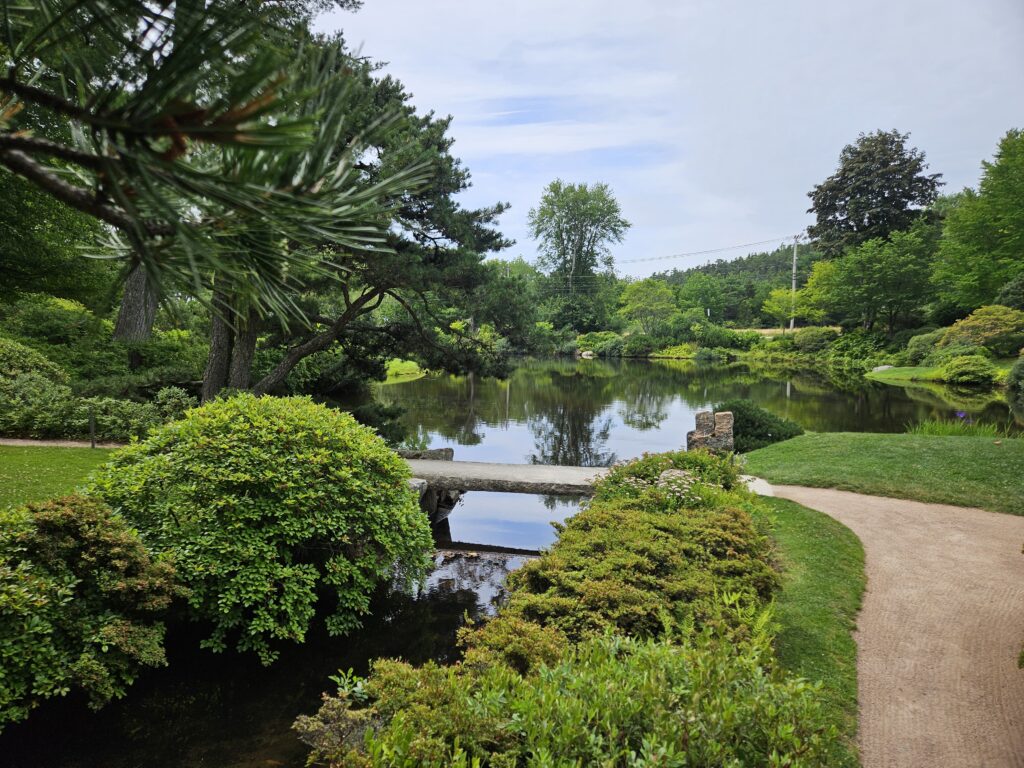
The Asticou and Rockefeller gardens were designed by renowned landscape designer Beatrix Ferrand. We explore the Asticou gardens on a beautiful, sunny day. Asticou Gardens are small, but contain a large variety of plants and the lovely sightlines make it feel expansive. (Someday we hope to have lunch at the Asticou Inn.)
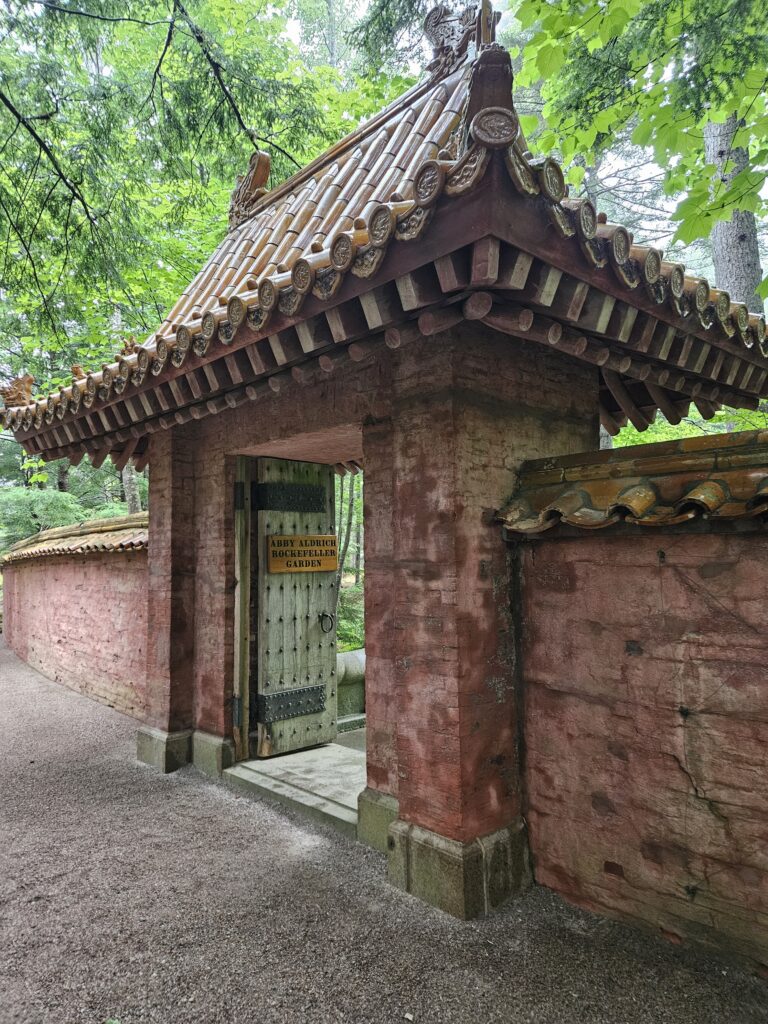
After touring Asticou, we ride back to NE Harbor and get on the bus to Bar Harbor, where we will do some light provisioning*. On the bus, we encounter a woman on her way to Abby Aldrich Rockefeller Gardens, which we learn has a limited number of timed-entry tickets available to the public; alas, there are no more tickets this day, but there are tickets available tomorrow (which is supposed to be stormy).
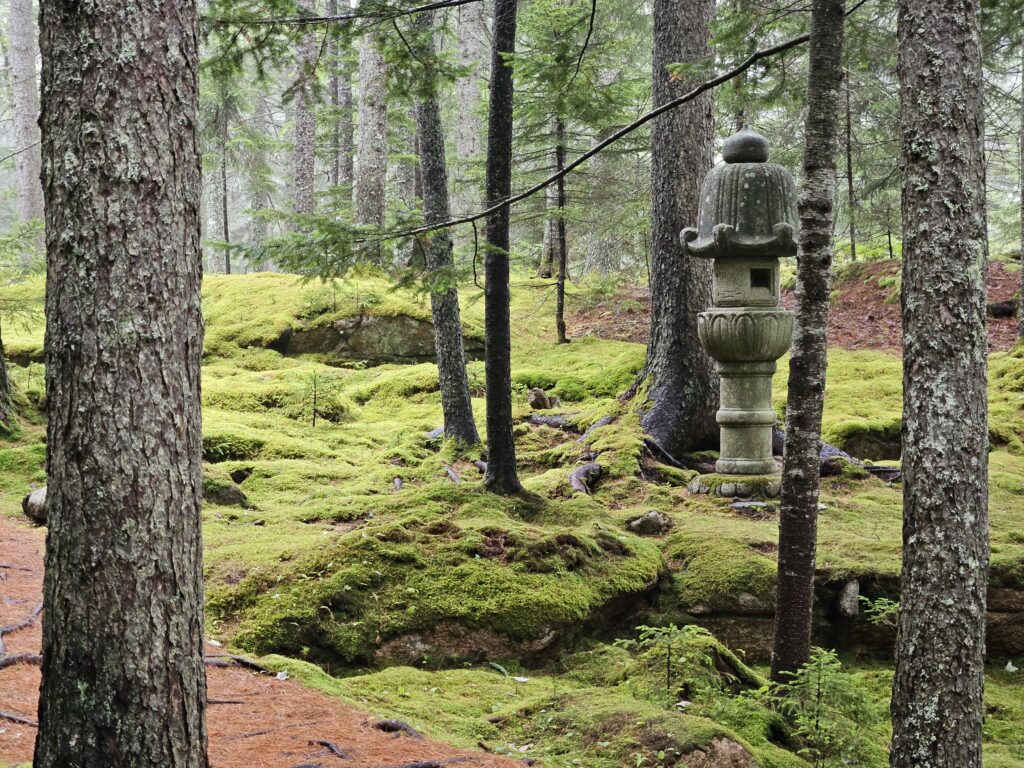
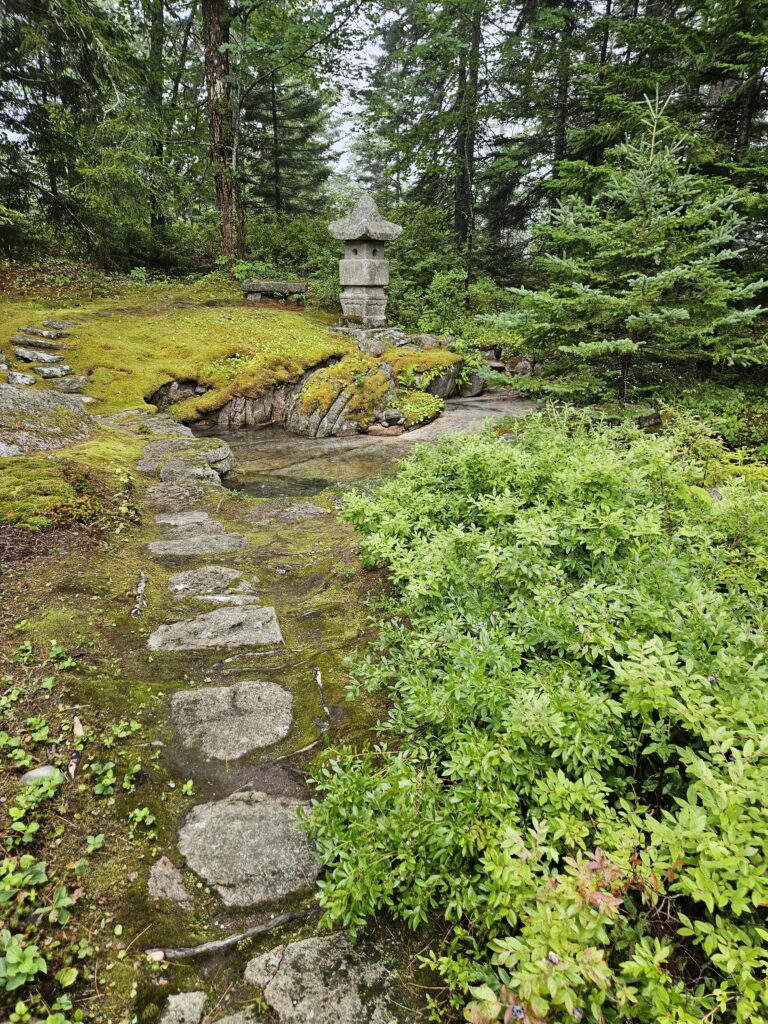
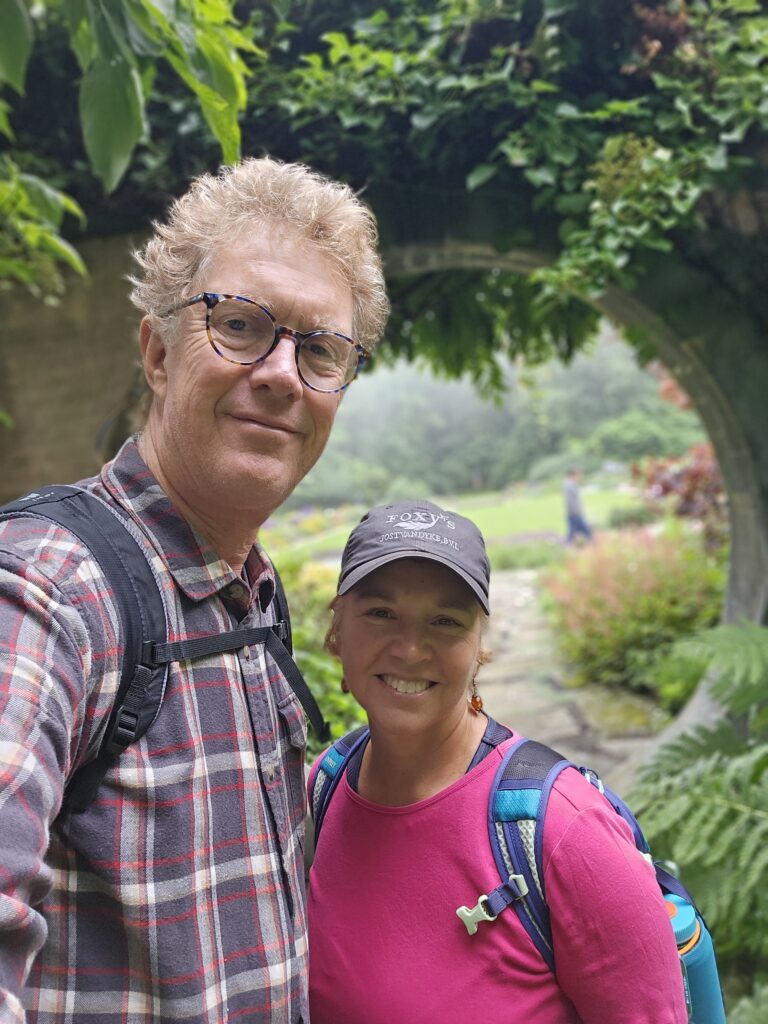
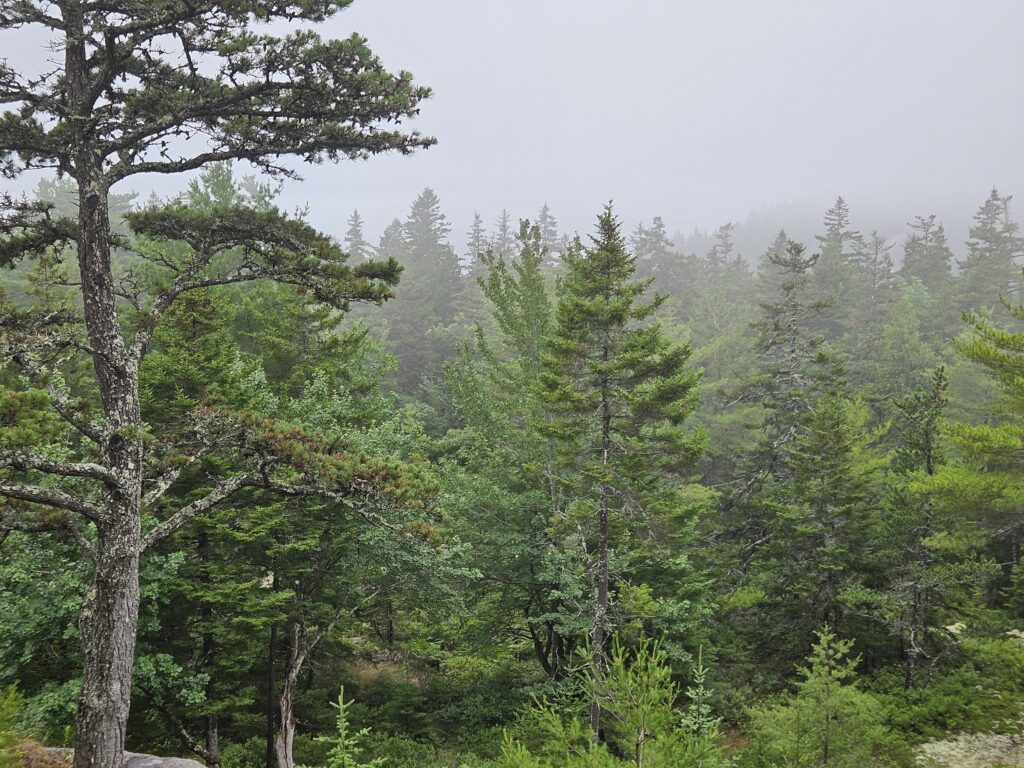
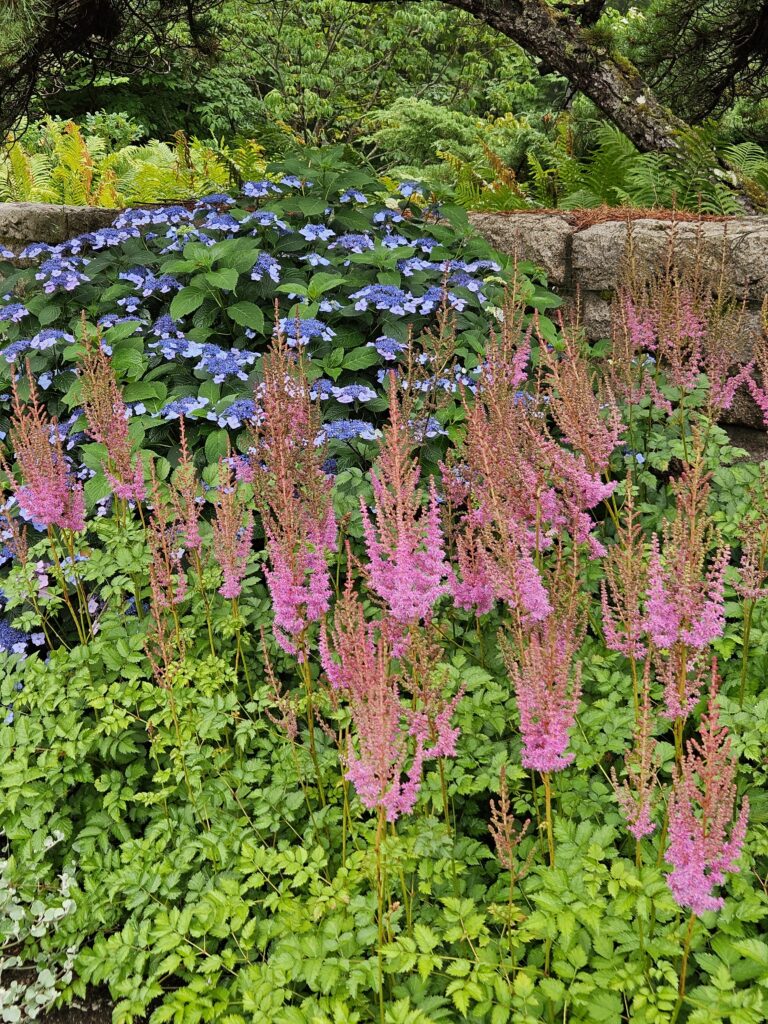
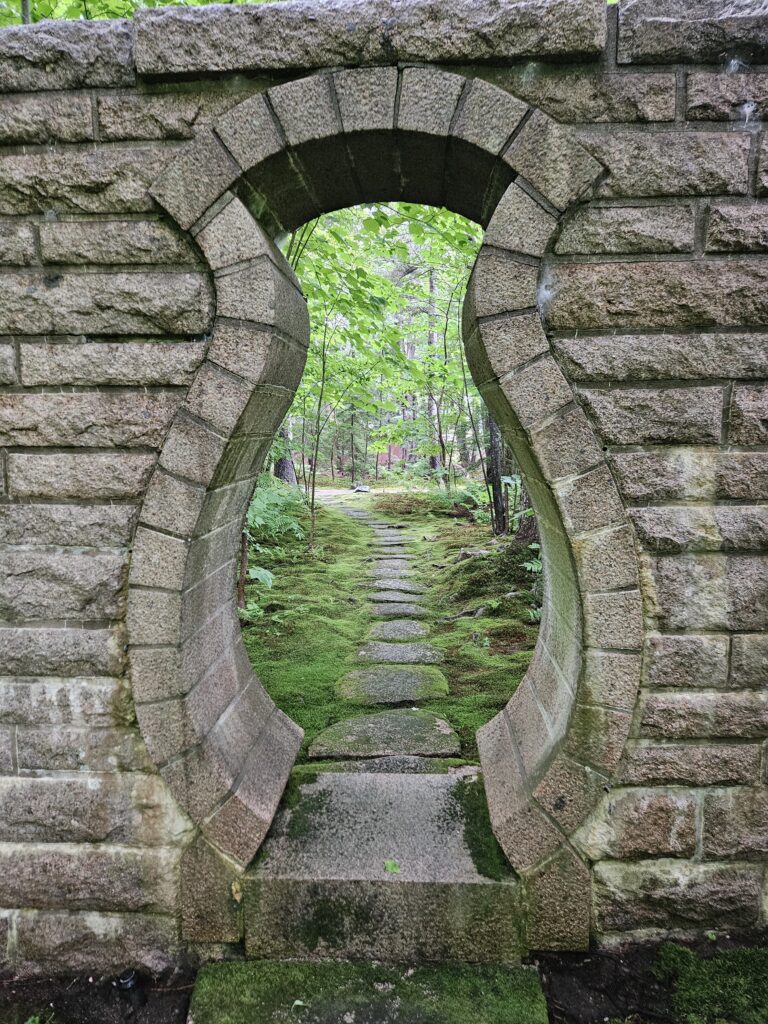
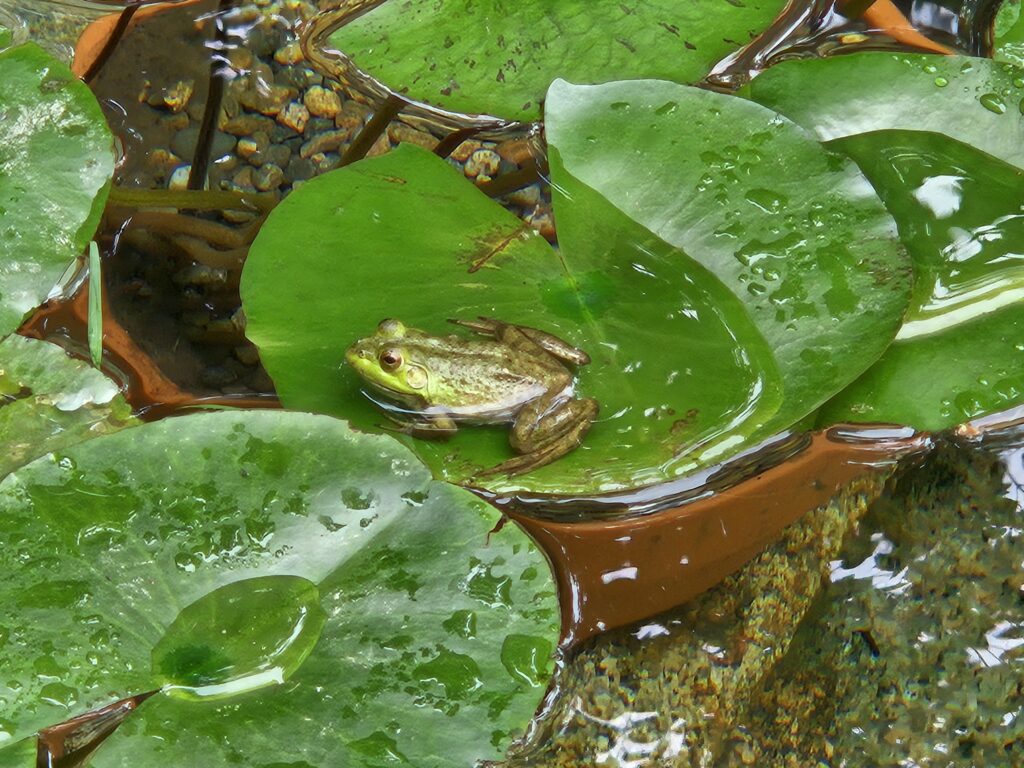
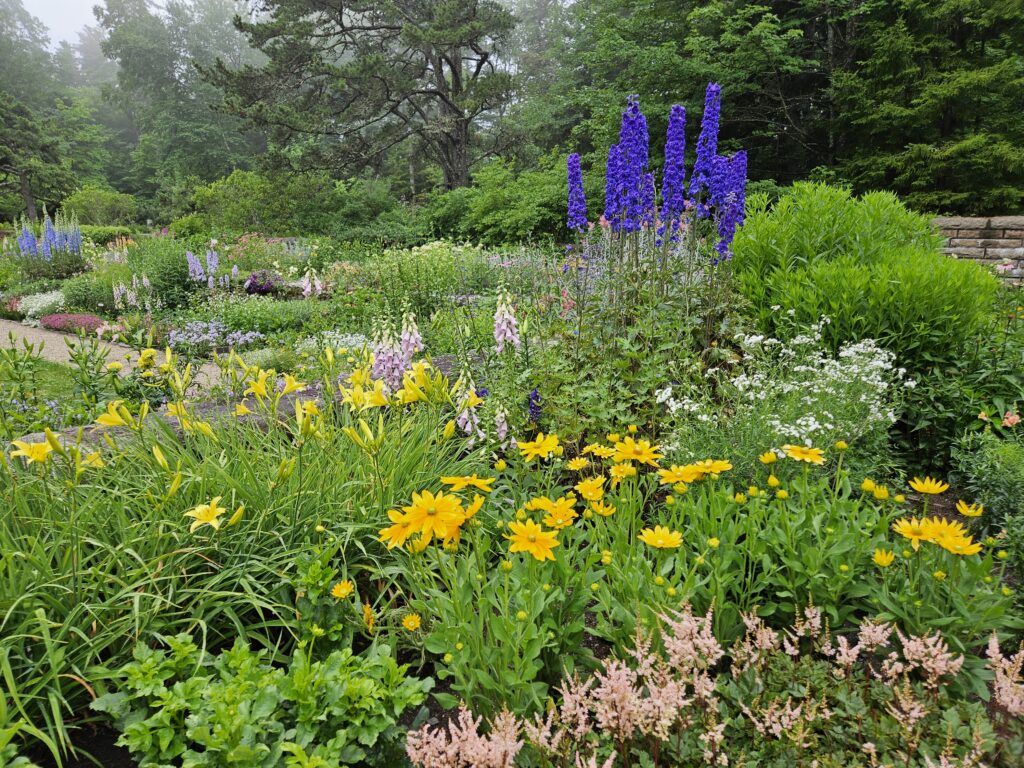
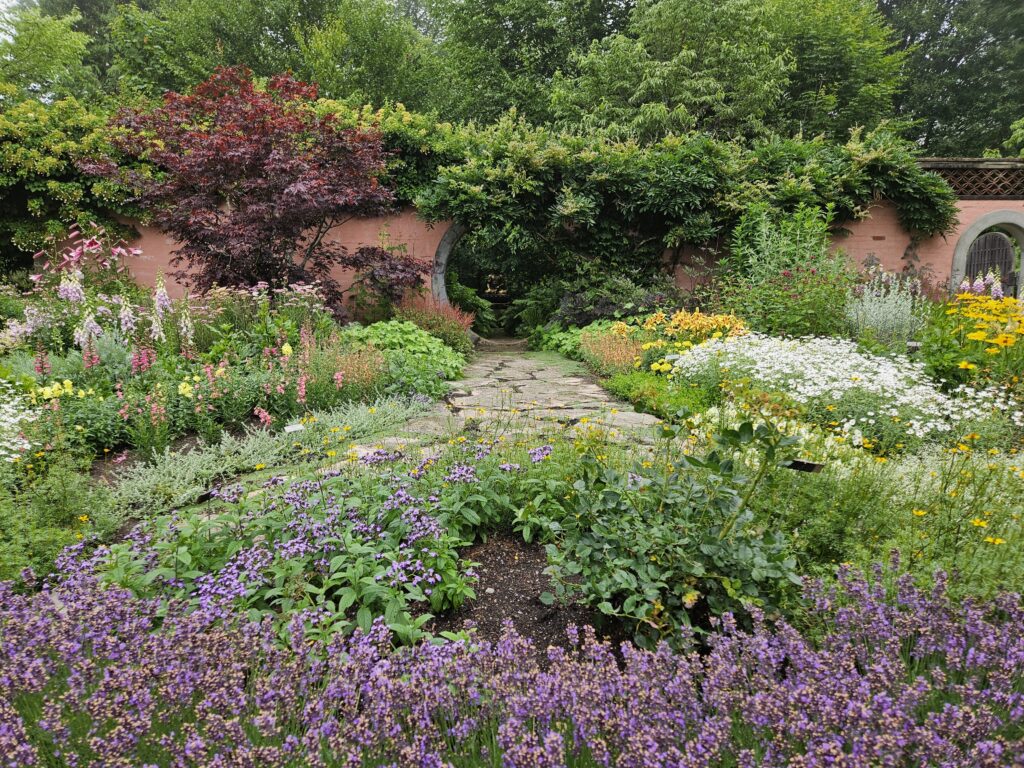
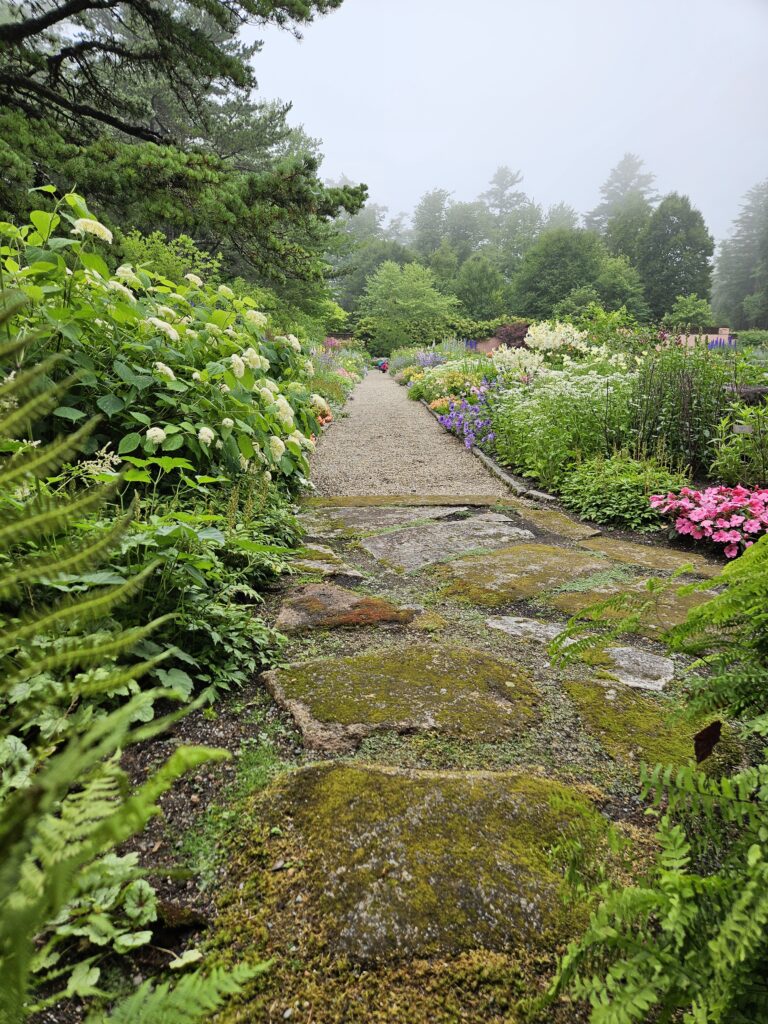
We examine the hourly forecast and it looks like all the really unpleasant weather is in the morning, and in the afternoon it’s just light rain and fog so we buy tickets for the next day at 2pm. These conditions, incidentally, turned out to be unbeatable for touring the Rockefeller garden! Light mist, fog, and the cool temperature make for an ethereal visit. We learn that the inner garden is designed to be yin (pale colors) on one side and yang (bright vivid colors) on the other.

Provisioning in Northeast Harbor
A note about provisioning in Northeast Harbor. The food market here (the Pine Market) is a big step up from a convenience store, but with really high prices. Watch what you buy. (Side note: there’s a wine and cheese store nearby where you can get really excellent cheeses (e.g., Humboldt Fog) for reasonable prices!) For a quick trip, go to Pine Market, but otherwise, take the #6 to Bar Harbor, which deposits you at Village Green. The Village Green bus stop is about a 15 minute walk from a well-stocked Hannafords Supermarket and an extensive Ace Hardware. There are various outdoor provisioning stores if you need to replace a backpack, or clothing (the Columbia, Kuhl, Patagonia goods are not much more expensive than back home), and Adrian was able to replace a cracked Nalgene bottle for $16 (Alpenglow Adventure Sports). So, bring lots of bags and maybe a folding cart, walk to Hannafords, and halfway back to the Village Green is a Shipyard Brewing Company where you can wet your whistle. So, if you can spare a day, you can have easy access to a superb supermarket. Note: although the Ace has lots of stuff, including varnish, for marine stuff, Southwest Harbor is better. More on that later.
We had Dinner at Nor’Easter Pound and Market – it was very good, nice atmosphere, outdoor dining, good food. This is as far as you need to go for a good meal.
Southwest Harbor
We shift from Northeast Harbor to Southwest Harbor. At Southwest Harbor, the moorings are more expensive, there is no launch service, and there are no services (no laundry, no groceries, no launch). However, there is a Hamilton Marine just a block from the “Lower Town Dock”, and there’s a defunct West Marine here as well. We visit both – Hamilton for a freshwater accumulator, a new door latch, and some other odds and ends. West Marine for 1/2 price docklines (we left our extra docklines in Deltaville, but ultimately decided we needed a couple more to be able to double up or tie up on all four corners, and also to replace chafed lines that happened in Rockport, MA).
Note that there are two “Town Docks.” There’s an upper town dock, which is closer to town (but not in town), and a lower town dock, which is a block from the Hamilton Marina. The upper town dock is apparently where yachties go, as it’s surrounded by rubber dinks. The lower town dock is where the lobstermen go – it’s surrounded by working dinks. Due to rowing distance, we go to the lower town dock, but our weather-beaten and scarred Walker Bay 8 blends right in. If you go there, leave your painter long (10ft or so) so other boats can squeeze in. The lower town dock is pretty rudimentary – it’s a working dock. The “bath house” is a sort of unisex toilet with (apparently) no lock on the door. But it works. No shower.
The West Marine is a bit of a hike. The hardware store, too. This is not a terribly convenient stop, but still, we liked it. The harbormaster and town clerk were super-friendly. Hamilton Marine is awesome, and is worth the visit in our opinion! It’s like a candy store would be for kids. But, their local inventory is spotty – call ahead if there’s something you need. They can generally have it on-site overnight. We want a new accumulator and door latch (mentioned earlier) and they don’t have it, but Gretchen says she’ll order it and it should be there before noon tomorrow. (We mention that we might leave late to the Harbormaster, and he says don’t worry about it. No problem.)
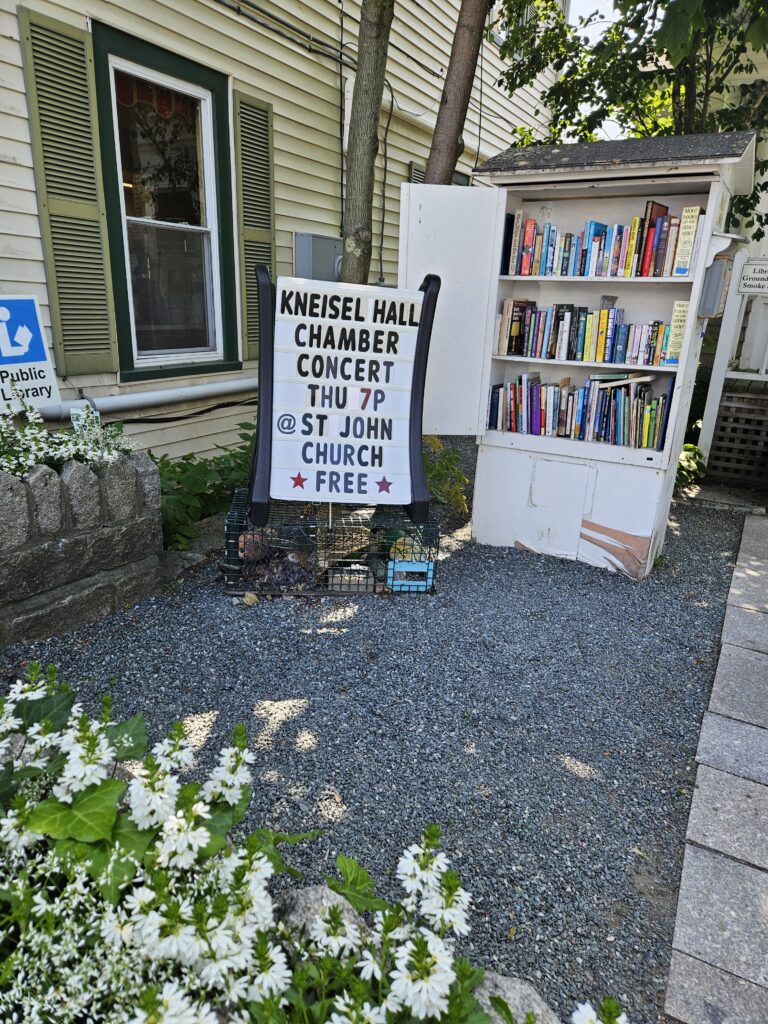
We walk into town and have lunch at the “Upper Deck,” which is fine. We walk past a sign indicating: “Kneisel Hall Chamber Concert, Thursday 7pm, St. John Church. *FREE*”. Well, the theme of this trip to Maine is music after all, and the price is right, so we go.
Oh My – what a concert! These are young adults, but they are second-to-none in their musical ability. They could go right out and cut an album.
The next day, as we wait for Hamilton Marine to open, we stroll into town for breakfast at the Common Good Soup Kitchen. They have free pop-overs (!), coffee, and live music (donation requested – of course, we make a donation). We saunter back to Hamilton Marine and, ta-da!, the accumulator and door latch are there.
Islesford (Little Cranberry)
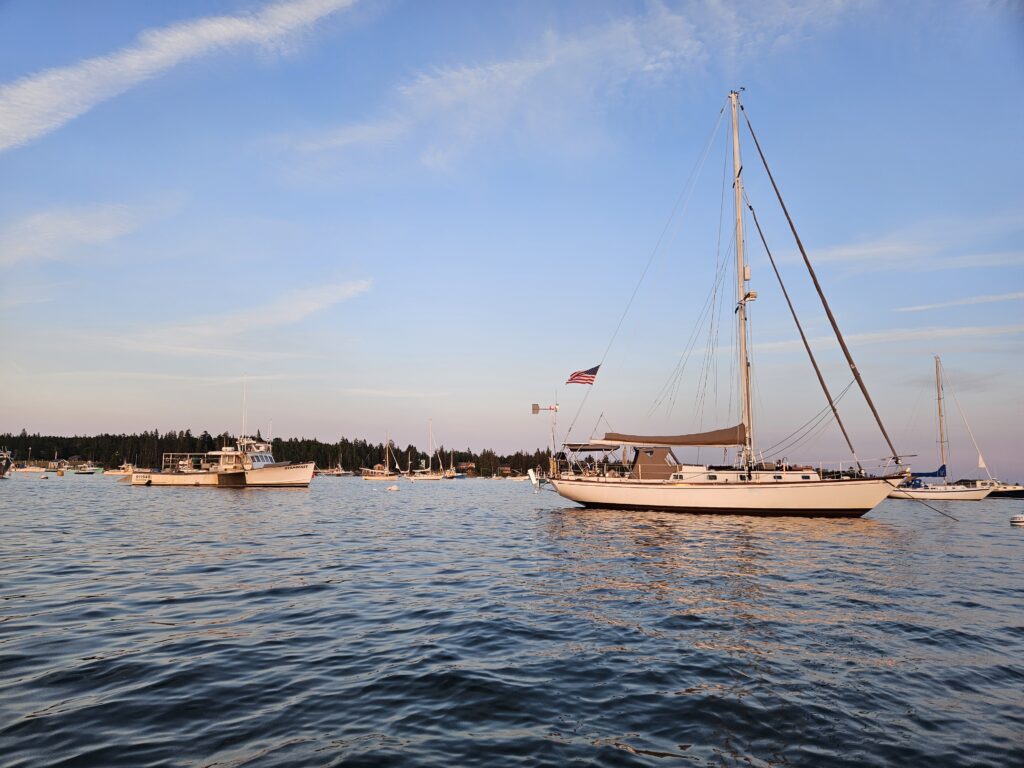
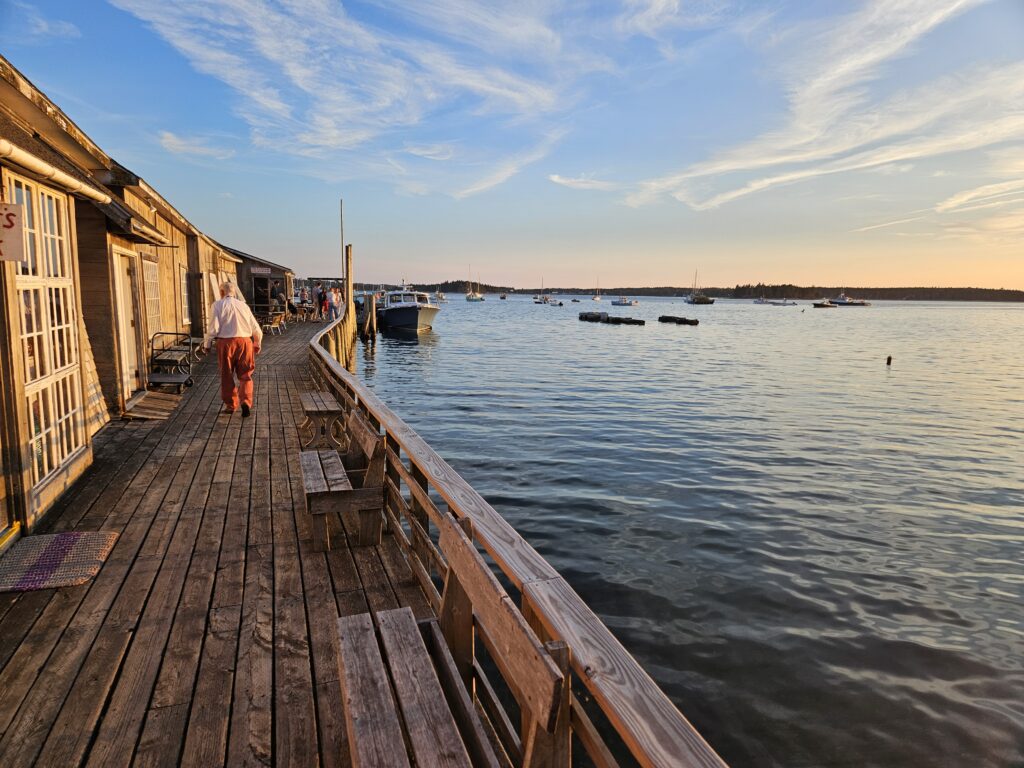
We move on. The next few days are predicted to be pretty settled, with the next front moving in some days later. So, we move to Islesford (i.e. Little Cranberry Island). We end up taking a free town mooring. We are excited to go exploring, but most things are closed so we just walk around in town. We make a reservation at the Islesford Dock and Gallery restaurant where later we have a delicious dinner before rowing back out to Canto.
Winter Harbor
From Islesford, we decide to visit the Schoodic Peninsula and Winter Harbor. Here, we thought we might find a place in the inner harbor. So, we call the harbormaster and ask about one, and they assign us a number, on a buoy “right next to a red boat”. The only red boat we see is way up inside the tiny anchorage and tied to a float. The only mooring near it is way too close to other boats to pick up, so we carefully turn Canto around and get out of there. We call the harbormaster back and express our concern that the space is too small, and he’s perplexed. Long story short, we were in the wrong place. The confusion stemmed from our having communicated with the Yacht Club (one cove up from where we were), and the mooring we want is next to a red Hinkley, not a red lobster boat. Haha. Anyway, so after all that, we end up on a yacht club mooring. There are places to anchor, though, and Winter Harbor is very pretty. It’s quite exposed to the south, so a visit there has to be timed to not be in a strong southerly.
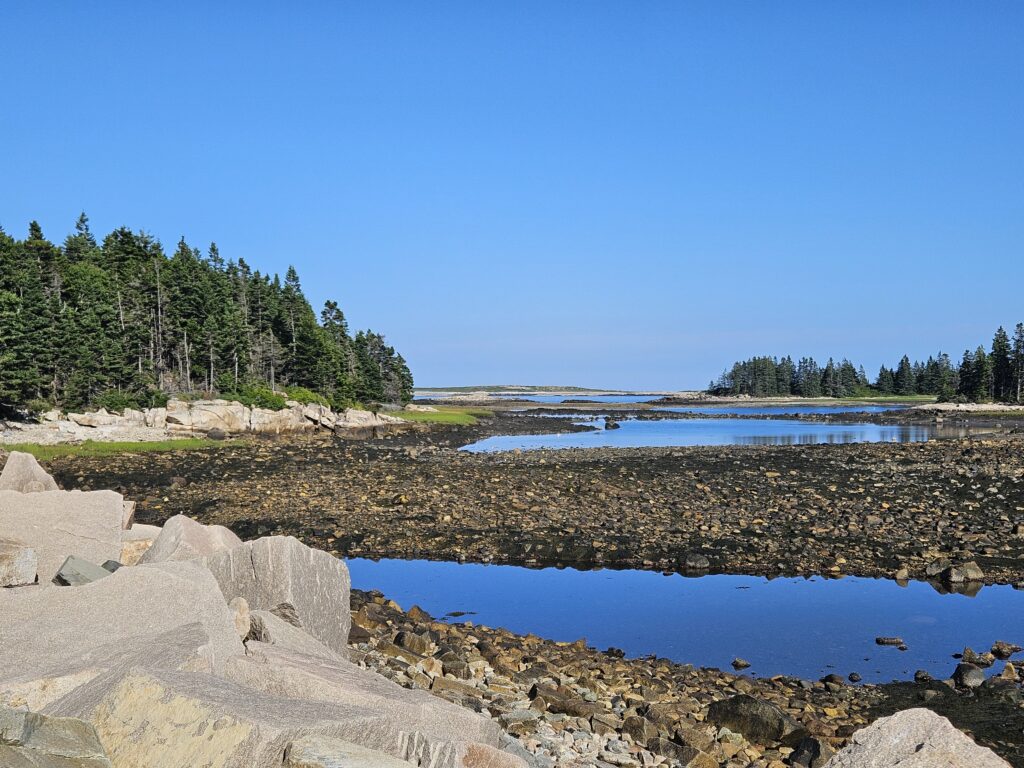
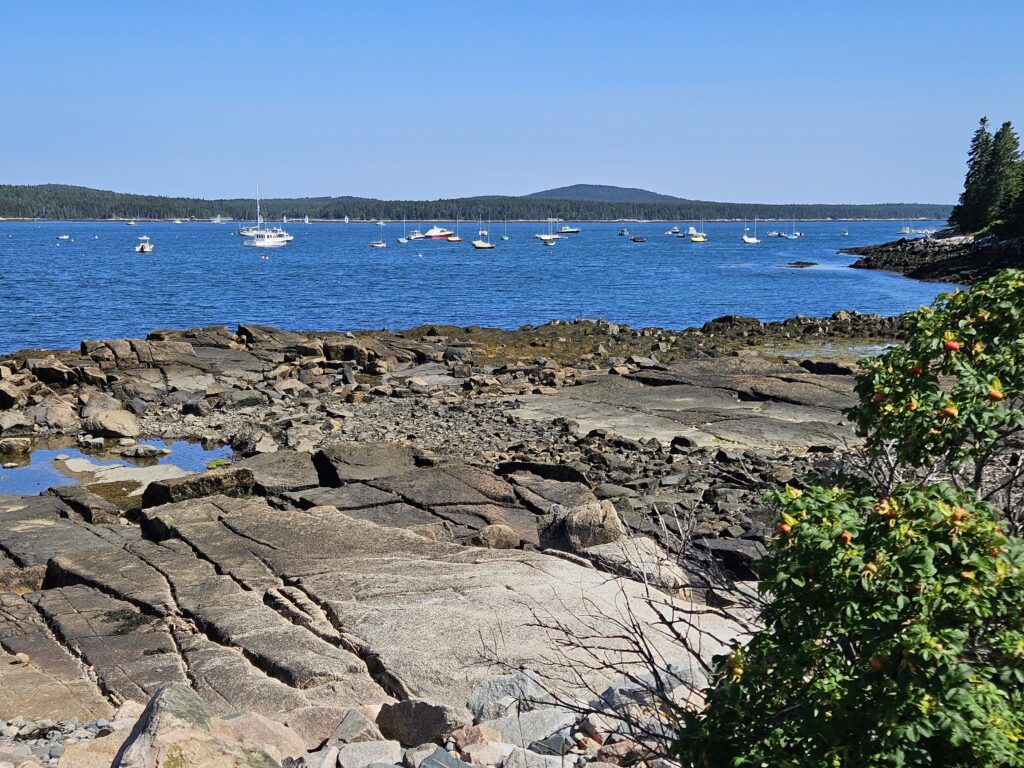
We bring our folding bikes to shore via the launch (which is included in the WHYC mooring fee), and ride a loop around the peninsula, which has lovely bike trails.
Winter Harbor seems like it’s 10 degrees cooler than any place around Penobscot Bay or Swan’s Island and the water temperature is 52 degrees, so the evening and morning finds us wearing our fleeces, long pants, and woolen caps and an extra blanket. We are reminded again of Samuel Clements’ proclamation that the coldest winter he ever spent was a summer in Maine! Maybe it’s time to head south again! Haha.
The sail back to Northeast Harbor (we need to stop there again, to have the action on my Mini Martin adjusted) is spectacular, complete with harbor porpoises, Cadillac Mountain in the background, and a delightful breeze, requiring only 1/2hr of motor at the beginning and end of the trip to have a warmed-up engine in case we need it (but we sail off and onto our moorings).
Sweet Chariot Music Festival
The sail to Burnt Coat, Swan’s Island, is a mixed bag. We do get some wind, but it is fickle, and we have to motor a bit. A deep fog sets in and we start manning the “fog horn.” In all this, we manage to pick up a lobster pot even though we are sailing (prop not spinning). We notice this because, suddenly, a lobster pot started following us. The water is 60 degrees – chilly but survivable, but we manage to wiggle it loose with a boat hook and some rudder action, but it’s unnerving. We think the line hooked onto one blade of the prop but, due to current, it was kept taught with the pots on the opposite side of Canto. Hard rudder action (once we lowered sails, etc) pushed it off the blade and it popped free.
We drop our anchor in a prime spot, straight out from the Fisherman’s Coop, in Burnt Coat Harbor a few days before the music festival, qith the intention of doing some odd jobs on Canto (including some varnishing) before the festival starts.
At low tide, we see a line floating up from the bottom, cut right at the surface. Adrian goes out in the Walker Bay and ties an orange juice bottle to it (we decide against using a whiskey bottle for this purpose since this is a dry island). Later, we flag down a lobsterman, who pulls it up and — it’s a pot belonging to one of his nephews, which had apparently been cut by a previous visitor. He is quite thankful, and offers us the lobsters within (but we don’t have a pot big enough for cooking lobster, so we tell him to keep them).
Our anchor seems to hold well, but we find ourselves obsessing over the nearness of a ledge. We go out in the dinghy and sound our swing perimeter, creating a small chartlet; it’s marginal for a very low tide, so we shorten our scope to 90ft (4:1 scope, which is marginal in a strong blow), which would leave about 1/2ft under our keel at a very low low, in a SW blow. Good enough for now, but we would feel nervous in a strong SW blow; looking ahead, there’s a proper SW blow (25kts gusting to over 35) coming in a couple of days that would put us roughly over the shallow patch. For now we’re OK, so we head to shore with the bikes so we can explore the island.
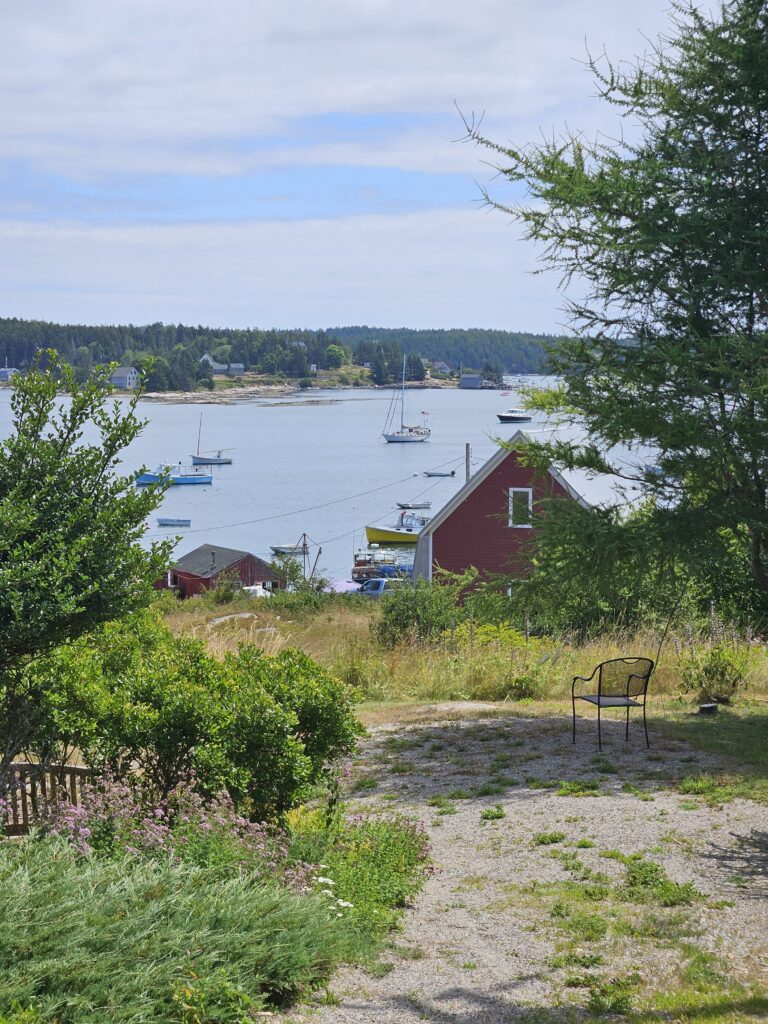
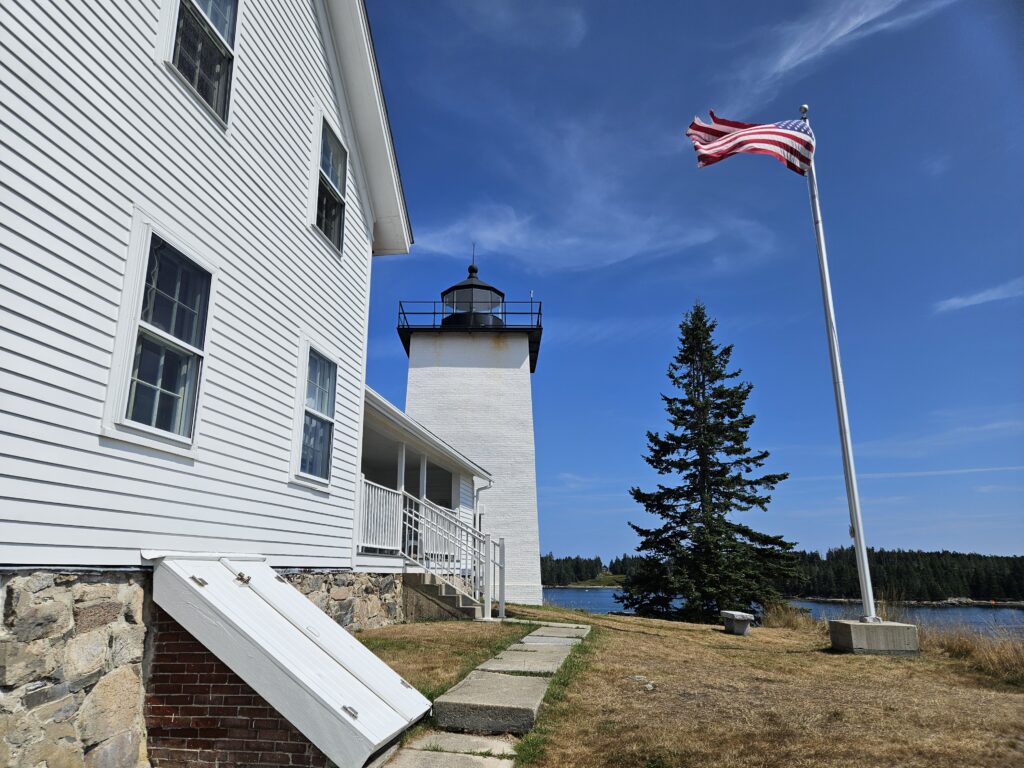
The weather is predicted to blow 25 with gusts over 35. With 4:1 scope, we’re a bit uncomfortable with our anchoring. There’s more room to anchor farther out, with excellent holding, but we’re in a rowboat and it would lengthen our row to 20 minutes or so. So on the day the blow is to hit, we decide to look for an empty mooring. We spy an unattended mooring nearby; the price ($30/night) and contact name is marked on the buoy, and a bottle is attached into which a check can be stuffed. This is the last open mooring, as people are starting to fill in for the festival and the up-coming blow, so we decide to take it – after all, it is a small price to pay for the added peace of mind.
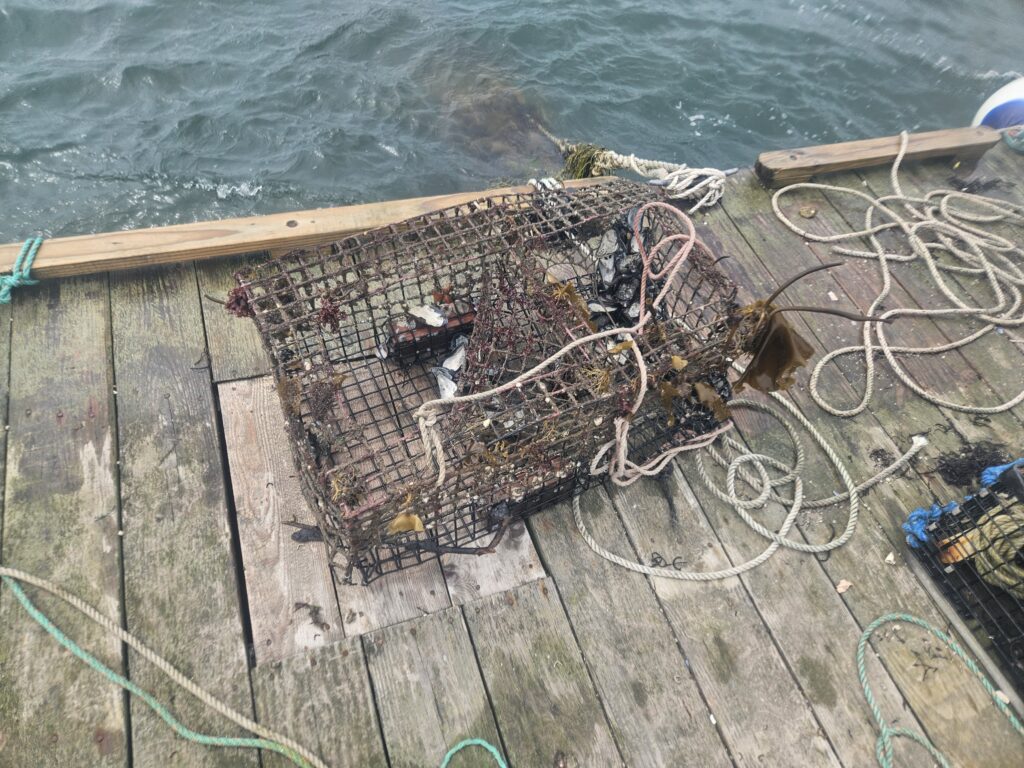
We raise the anchor and are glad we do. While it does come up, it’s covered with kelp and has a lobster pot hooked to it. We may have hooked the pot as we were raising anchor, as it is now windy we probably dragged the anchor some yards when the scope was nearly vertical. We tie up to the mooring and then have to figure out how to get the disgusting, kelp-and-mud-covered, abandoned trap off of our anchor. We don’t want to just dump it back into the harbor for someone else to trip over, so after de-kelping it, we drop it into the dinghy (yuck) and Adrian rows it to a nearby lobster work platform. He cleans out the now-muddy dinghy, but he, himself, ends up covered with mud. It is the work of an entire morning to clear the anchor, deposit the pot (in now-rough water), clean the dinghy, clean the skipper, clean his clothes. Much cleaning this day. The wind picks up, and going ashore becomes an endeavor only undertaken by desperados. Not being desperados, we stay aboard and work on the computer, clean siphon breaks, polish the engine, take naps, etc.
We enjoy a simple dinner, start an episode of Downton Abby (which we started watching) and are about to turn in when we hear faint voices:
“Helloooo! Hellooo! Help!! Can you help us?!” We look at each other with “Did you hear that?!” looks on our faces, and then rush upstairs. There, 30 feet distant, in the dark, wind blowing all of 25kts and more, is a disabled 45′ sailboat drifting past, headed more or less towards the very shoal we were aiming to avoid earlier. Their anchor is deployed but ineffective and their engine has “quit.” We triage by getting a line on them (using our dinghy, which was deployed and ready) and tying them off on our stern to arrest their drift towards the ledges.
Then, suddenly, half a d
three cruisers from the anchorage arrive in dinghies, wearing foulies. With their help, and using our capstan to pull them forward against the building wind, we secure the hapless disabled vessel alongside Canto. The mooring seems beefy, but we text the owner to be sure, and he confirms it should be fine. Crisis averted. The wind seems to have plateaued and is now easing up a little, so we all turn in for the night. It is very heart-warming how cruisers all pull together in a time of need!
Later, the story unfolds: They were at Devil’s Island / Hell’s Half Acre, and the NYYC (100+ boats strong) came in and started anchoring all over the place. The wind built up, that spot is not great for a strong wind, people started dragging, so they left, into the building wind and waves, to make Swan’s Island. When they got in, just before dusk, there were no mooring available and their anchor wouldn’t hold (note, there are very kelpy areas in Burnt Coat, and they probably tried in kelp). They tried 8 times and then the engine suddenly quit. And that’s when they started drifting down to our area of the anchorage.
It should be noted that Swan’s Island and its environs is carpeted with lobster pots and their evil cousins, the “toggle.” Toggles are double-floats. One float, called the “toggle” is to the lobster trap and keeps the trap line vertical more or less. But in strong current, that line might submerge, so a second float (the “spindle”) is attached to the toggle ABOUT 2 FEET BELOW THE SURFACE and then crosses over to the spindle JUST BELOW THE SURFACE. These can be 50 ft apart. Pass between them with the wrong keel shape and you are caught. Add current and wind for extra-spicy.
The next morning, the breeze has moderated, and after we share coffee and biscotti with our new guests, they dive into the water and confirm they’ve wrapped a lobster pot warp around their prop shaft. They can’t seem to get it all loose as it’s very tightly wrapped and jammed into their cutless bearing – if only they could stay down longer to dig it out. Well, say no more – Canto is a full-service facility. We pull out our SCUBA gear out of our bilge and they are just amazed. Long story short, they get the prop cleared up and are back on their own power later that morning. Another cruiser, leaving, offers them their mooring so they have a place to go. They are most grateful: they own a private mooring in Rockport, and said, if we ever need a mooring, we are welcome to use theirs.
We use our folding bikes to explore Swan’s. Along the way, find Suzette’s. Suzette is very friendly and loves to garden. We buy a bunch of freshies. Her tomatoes are the most succulent we’ve ever had.
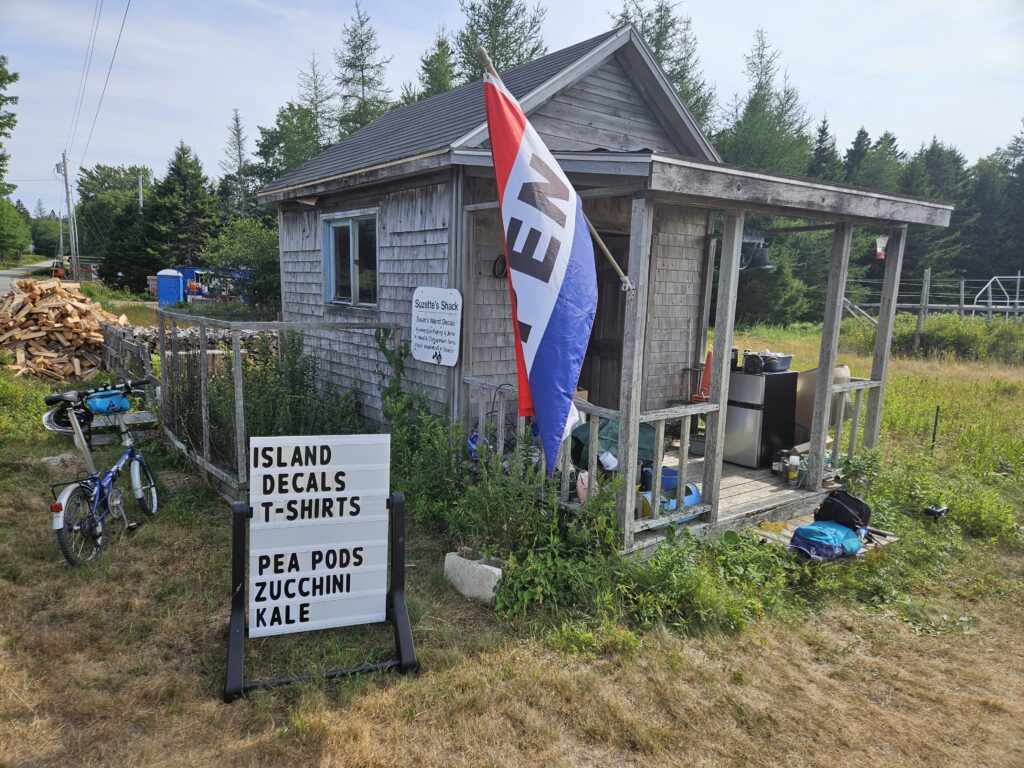
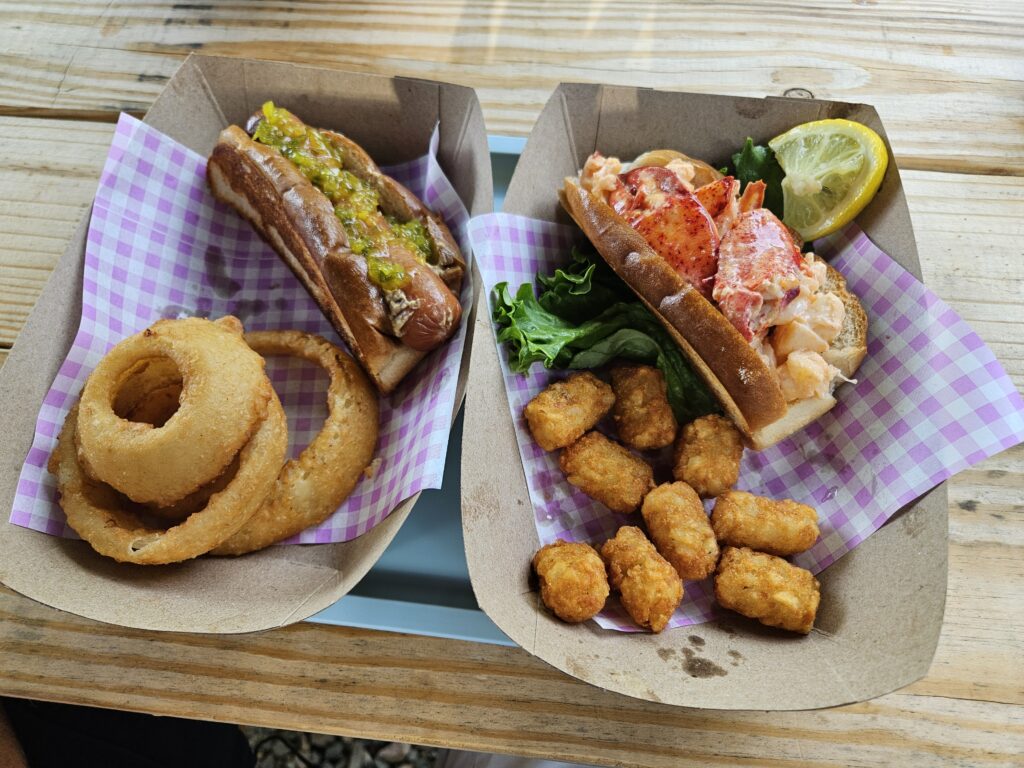
Next door, the “Mainesota Food Truck” is selling delicious food, so we have an early dinner. The lady who catches the lobster also cleans, cooks, and brings them to her food truck to serve up. And they have tots! Yum!
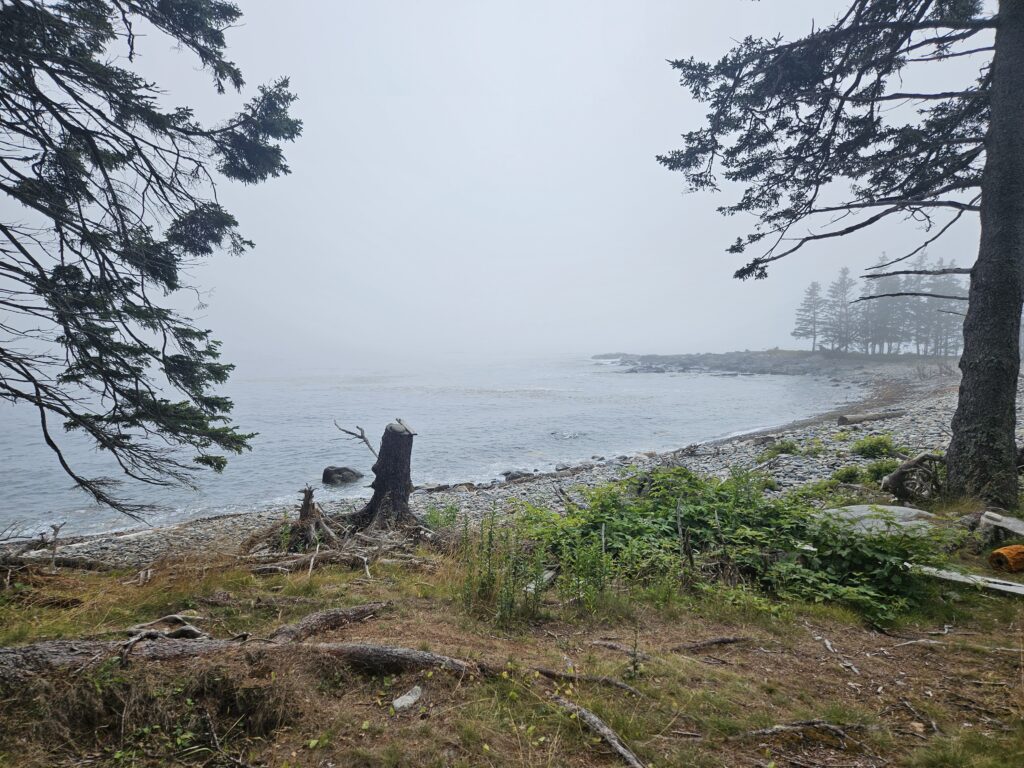
Another, misty day, we ride out to the lighthouse to enjoy the hikes and the views.
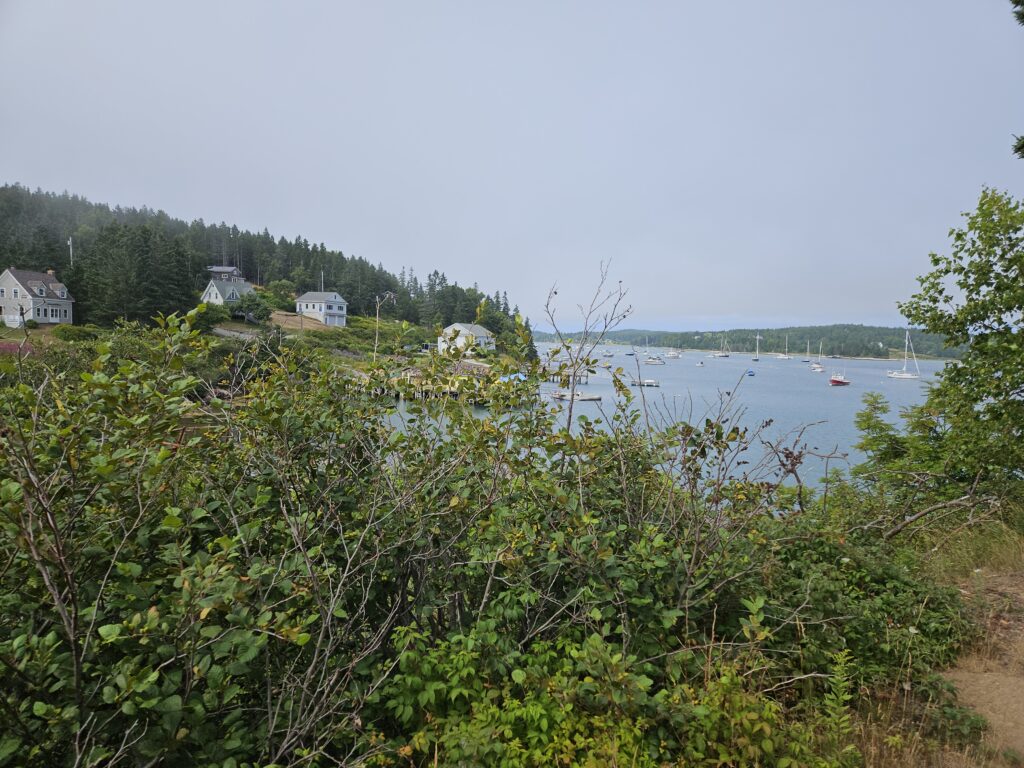
One sunny day, we walk (3 miles) to Fine Sand Beach, which is just that – a fine sandy beach! It’s delightful, with 65 degree wate and fine sand. Perfect for whiling away a hot day.
Sunday mornings, Oddfellows provides breakfast (All you care to eat) from 7 to 9. We go to this and meet some locals, as well as the daughter (and her family) of a good friend from Deltaville! The breakfast is very good and has everything you might be wanting from a breakfast.
The Sweet Chariot music festival begins with sea shanties sung from an itinerant trawler. [Click here to see video on Youtube]. Then, around 6:30pm or so, you walk up to Odd Fellow’s hall.
We didn’t know what to expect, but it was excellent. Among the many talents there were the Clement’s Brothers, Kathleen Parks, The Boom Chick Trio, and many more. Check them out!
The first night of the festival, we return to the dinghy dock to find our dinghy has moved to the other side. At first we panicked and thought someone had stolen it. Then we thought maybe it had come undone and was on the rocks somewhere. Then we found it tied in a completely different location, with a improperly-tied attempted bowline! Dinghy space at the Fisherman’s Coop is very limited, and many actually went to Kent’s Wharf (we didn’t because the people there didn’t want us to tie up there). We think another cruiser retied our dinghy, thinking perhaps it was a local’s dinghy (the locals here actually own a bunch of Walker Bays), to make more room at the inflatable-congested float.
Before leaving, we sail the Walker Bay over to Trafton’s Wharf and walk over to the swimming hole (an old rock quarry). The water temperature is refreshing but not cold, and the water is fresh. This is a great place to come hang out on a hot summer day. Also, Trafton’s Wharf is most welcoming, and deserves more exploration. FWIW Trafton’s offers moorings, and while these are quite far removed from the “center” of activity formed by Oddfellow’s Hall and TIMS (The Island Market Store), Trafton’s has picnic tables, had parties on some nights, sometimes cooks lobsters. It’s a happy place.