We’ve had our current set of Deka Solar 8GGC2 Gel batteries in our boat since March of 2014 – both house bank and engine bank. And they’re getting a bit weary. So, this year, we are upgrading the house bank to LiFePo4 and the engine bank, well, it just stays Deka Solar (but newer batteries). Upgrading to lithium, we replace our 360Ah house bank with 460Ah. (The engine bank will remain 180Ah of Gel.)
Doing this necessitated replacing our ancient ferrite charger, separating our house from our engine bank (previously, combinable with an “OFF-1-BOTH-2” switch), and providing a way to charge the house bank using the alternator (from the engine bank).
Since we’re replacing the charger, we thought we’d install a proper inverter. So, we obtained a Victron Multiplus II 3000W 12V inverter/charger) and installed that. This, in turn, required updating the cabling (to 4/0) to handle the potential capacity. NOTE: We will probably never use all 3000W of the inverter, but if an upgrade to do so is ever done, at least the cabling’s already in place.
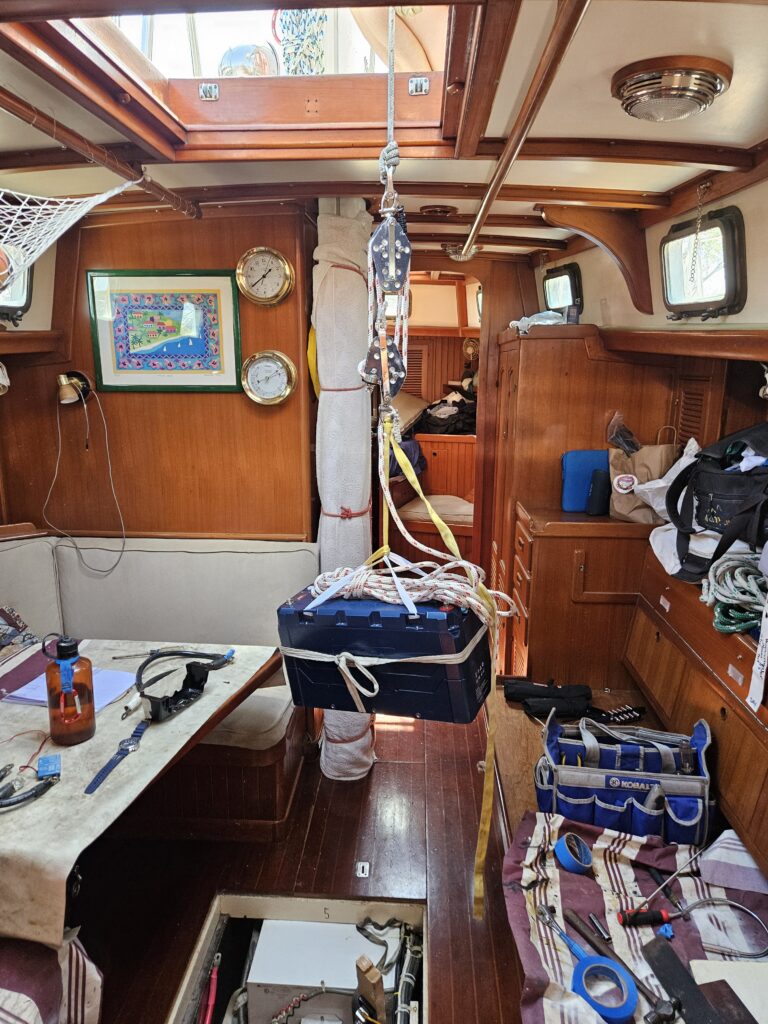
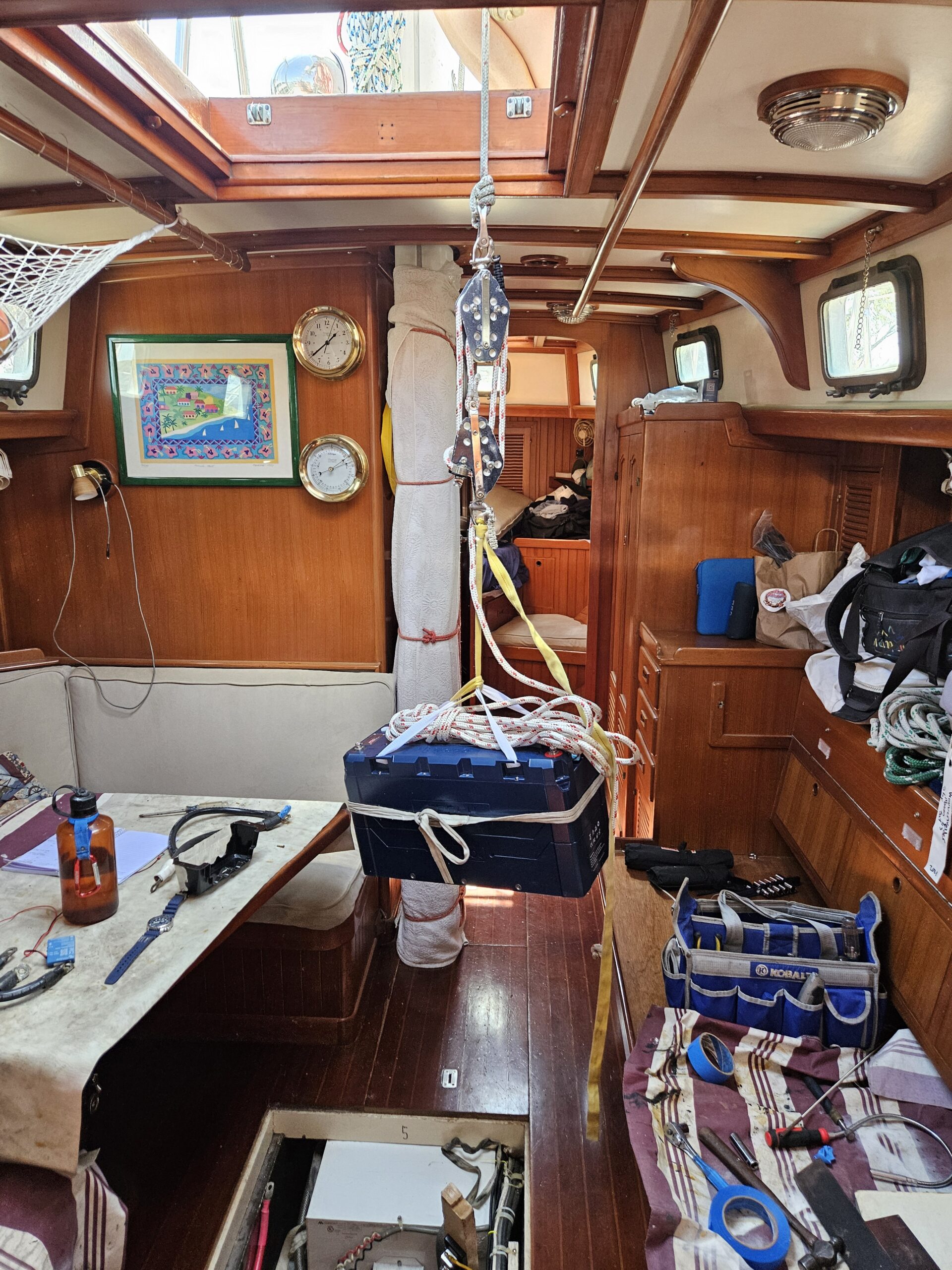
Lifting in the new 100lb battery, from a dock cart, was accomplished by using the main halyard and a block and tackle to hoist the beast through the main salon hatch and then slowly lowering it into its new home.
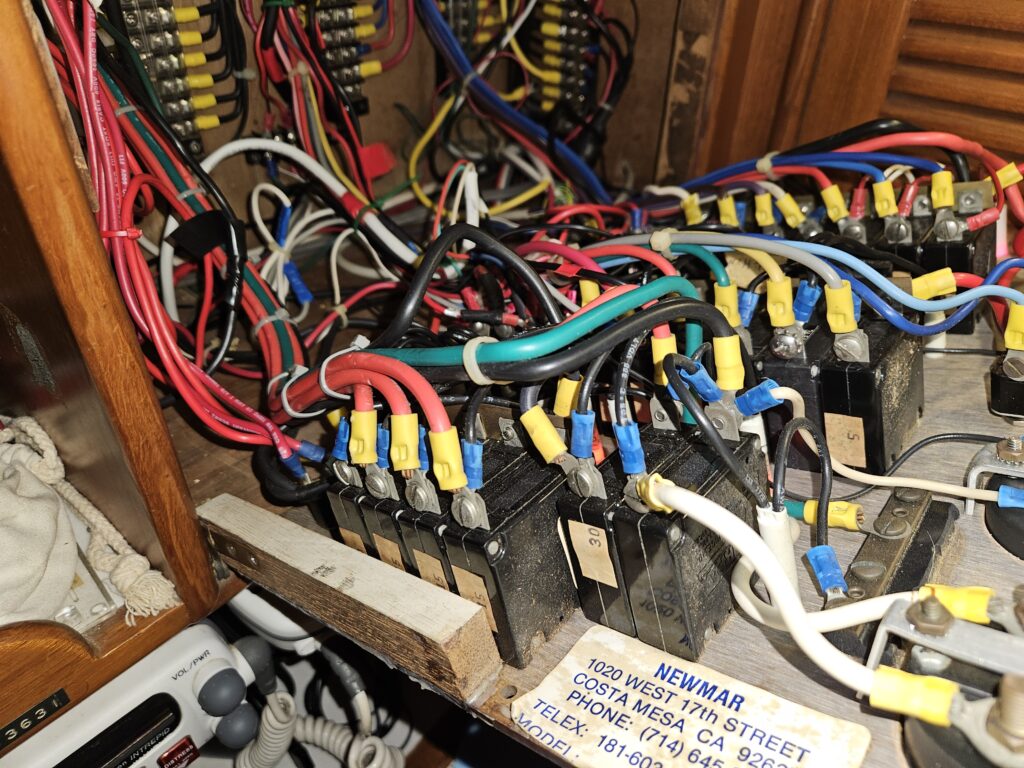
Some rewiring was also necessary in the distribution panel. Here, we had to redirect the AC Mains to go to the new charger, and then pull a new wire from the inverter back into the distribution panel. This, of course, meant crawling around through the bilge, removing paneling, etc. Fun work.
Solar and wind were previously combined; however, our wind is unregulated and so cannot be safely hooked up to the lithium battery (which is highly intolerant of overcharging). A load-dumping controller could be had, but the best solution appeared to be to keep wind on the gel engine bank and solar (with MPPT controller) on the lithium house bank. If the wind is up, it will top off the engine bank prior to spilling over (via a Victron Orion XS 50A DC-DC charger) to the house bank. Doing this places a load on the engine bank, thus buffering it from overcharging as well by directing the charge to the house bank. We don’t leave the wind generator unattended, so this is a pretty good solution for safely harnessing wind energy.
I included a toggle switch on the Orion XS DC-DC charger so that it could be turned off when the battery SOC (state of charge) indicates the batteries are already full enough.
We installed the Epoch battery monitor at the nav station so we could monitor SOC easily. Note that this instrument was much too bright, but a pair of eye protectors from our ophthalmologist’s office, cut into just the right shape, solved that problem.
Initial testing looks very good! We have been unplugged from shore power since the upgrade.
- The 3000W inverter easily boils water in our electric kettle, costing us about 2% battery SOC for each quart we boil.
- The fridge freezes water solid
- We are no longer obnoxious about turning off cabin lights at night
- On a windy day, we let the wind generator run on the engine bank, and the Orion XS DC-DC charger kicks into spillover mode and starts charging the house bank without lowering the engine bank voltage below float voltage
- On sunny days, with our 240W solar, there is enough input to recharge the house bank to full without running the engine
- Running the engine, the Orion XS kicks in and charges the house bank at the fully-rated 50A without overburdoning our 100A alternator.
Now it is time to try it all out by going cruising!