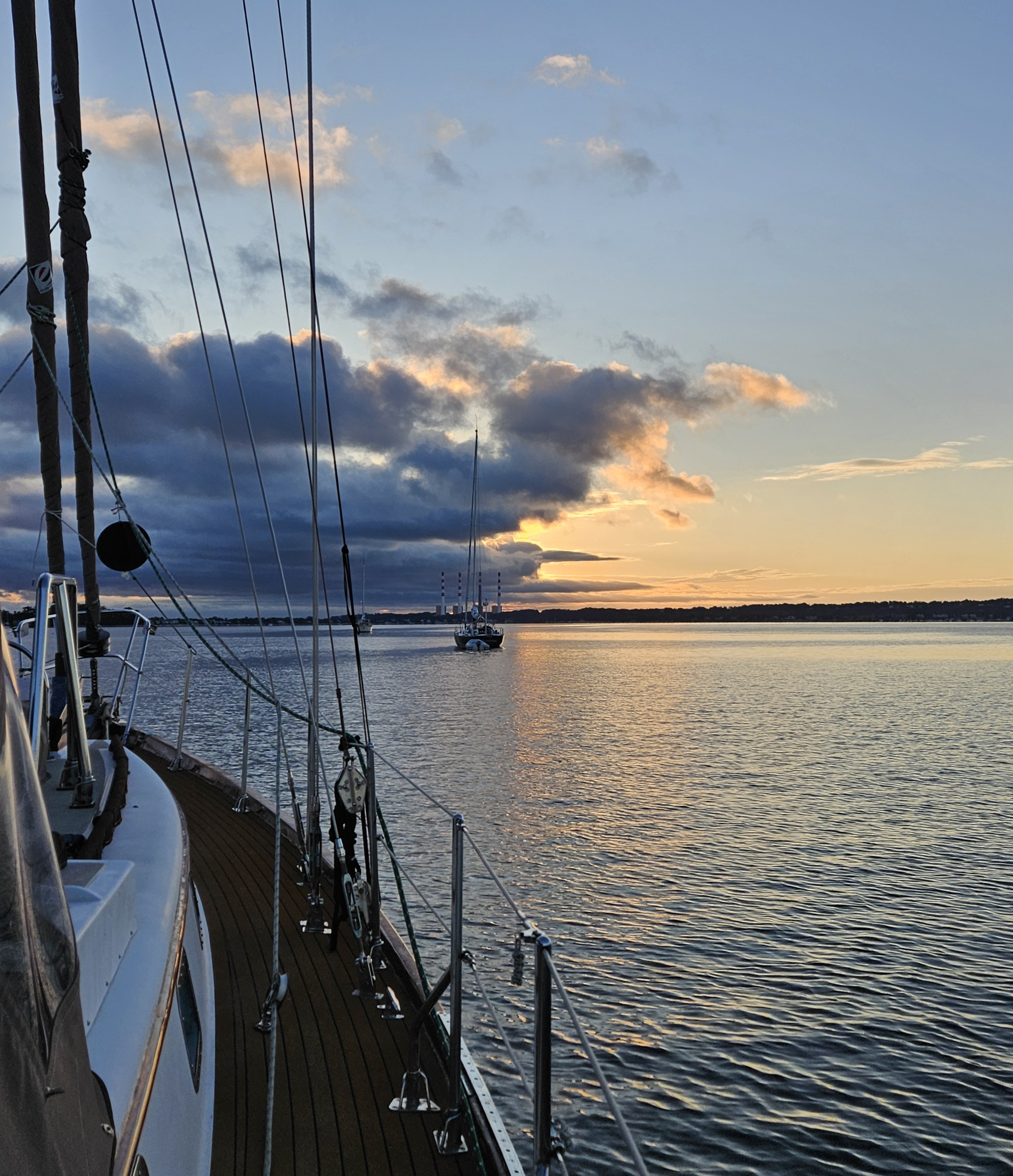
Matinicus to Gloucester
We leave Matinicus at 08:50 on Friday, August 21, and mostly motor to Gloucester, MA.
During the night passage from Matinicus, the wind dies below the threshold where the headsail stays filled in the rolling swell, and so, to prevent wear and tear on the jib, we furl it. We have already stowed the mainsail as it was just crashing back and forth. In our sleepy stupor, we end up wrapping the sheet with the jib. The wind is enough that the jib is tight and now is flogging, and we can neither furl nor unfurl the flapping cloth. So, at 01:55 (exciting things on cruising boats always happen at 2am, for some reason), using our spreader lights and headlamp, we un-reave the sheets (taking care to first belay them so they don’t swim down to our prop), coil them on the foredeck, and manually unwind them until they were no longer wrapped around the headsail. Then we re-reave them. This has the side effect of making it so that there was only just enough furling line on the drum to completely furl the jib (we had to pass the sheets around the sail 5 times, and now the furling drum has zero wraps left with the sail only just furled – we like 3 or 4 at least in case we get a tight wrap in a heavy blow, and like 2 or 3 wraps of sheet around the furler to help hold things down), but it is good enough for the night, and we can easily deal with the re-wrapping issue in Gloucester (which we accomplish by simply un-reaving, etc., while at the mooring, in daylight, with light wind, in a controlled fashion).
When we arrive, we decide to pick up a town mooring since the tiny triangular area which used to be designated as an anchorage there is now filled with moorings, and the Eastern Point Yacht Club (which was our favorite!) no longer accepts transients on reciprocity. There are anchorages, but ultimately, the mooring is not that expensive and is very convenient to town. And, after our offshore passage, we just wanted to tie up and nap.
We rest-up in the morning (Saturday), then go on a self-guided harborwalk. It should be noted that Gloucester has a well-appointed (awesome!) Ace hardware store within easy walking distance from the town dock. We pick up a few small items.
The following day (Sunday), we decide to visit the CAM (Cape Anne Museum) which is featuring works by Rothko, Gottlieb, and Avery. This pleasant indoor activity is especially suited for this day as it is rainy and cloudy.
Gloucester to Salem
On Monday, August 24, we head for Salem. We sail (slowly) most of the way, and end up at a free Safe Harbor mooring. We have arrangements for a free Safe Harbor (free) slip starting on Tuesday in Quincy, MA.
We go ashore using the complimentary launch and visit the place where the Witch Trials took place. The visitor center there has a nice retrospective reenactment video on the witch trials, why they happened, how they happened, how individuals were selected as witches (and warlocks).
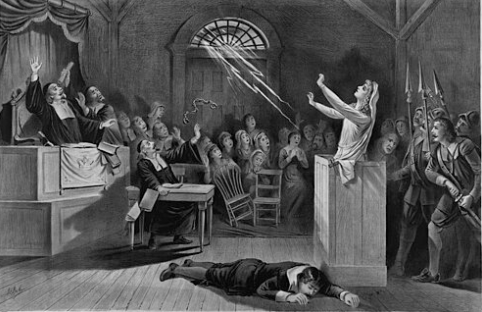
It’s nearly inconceivable that people were killed for being witches based on the testimony of children. A child would be beset with seizures and odd behavior, and upon touching the accused, would (if the accused is the witch he or she is supposed to be) be instantly cured. “Spectral Evidence” is what this was termed. “Inconceivable” it would totally be were it not de facto, and were there not, even this very day and age, for the presence of superstitions and biases strong enough to compel homicide.
Ironically, one can now buy all sorts of witch and magical paraphernalia in Salem, a fact in which those accused and executed for witchcraft in 1692-3 would doubtless have found no amusement, had they had the prescience to know. Imagine: “Some day, some 430 years hence, there shall be markets from which good townsfolk can buy a ‘Book of Spells’ without repercussion as easily as one might today purchase a horseshoe! Now go hang.”
Salem to Quincy
Quincy is one of our “destinations!” Safe Harbor Marina Bay has graciously extended 3 free days in a slip to us at this swanky place. We sail from Salem to Boston, but it takes nearly the entire day due to light wind – we know how to turn a 15 mile sail into a 10 hour affair. Because we’re mostly drifting quietly, we do have the fortune of seeing and hearing some Minke whales; one submerges, swims right under our boat and surfaces on the other side! Under the boat he/she turns sideways and peers at us through one eye, checking us out. Fantastic!
In the end, we must motor from the Boston Harbor Light to the marina if we are to make it in before dark.
Marina stays are always exhausting since they’re opportunities for getting chores done. We use this stay to refill our fuel, refill our water, do our laundry, restock on groceries (using the folding bikes), change the oil, change the fuel filters, restock on filters, make some sail repairs, etc.
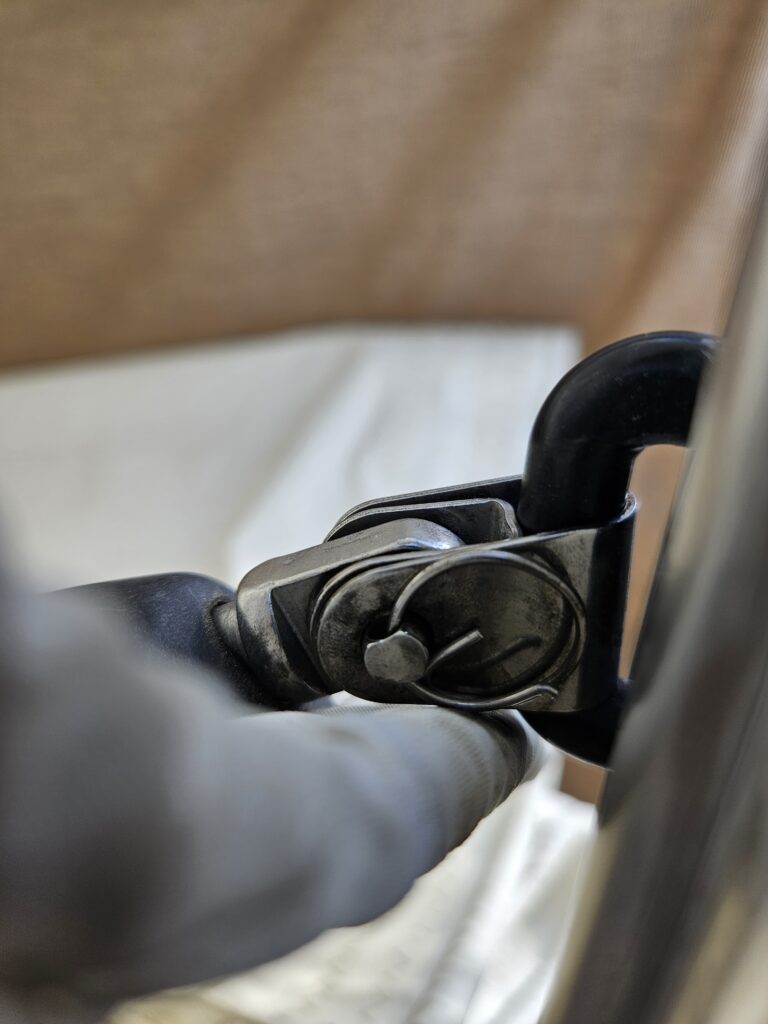
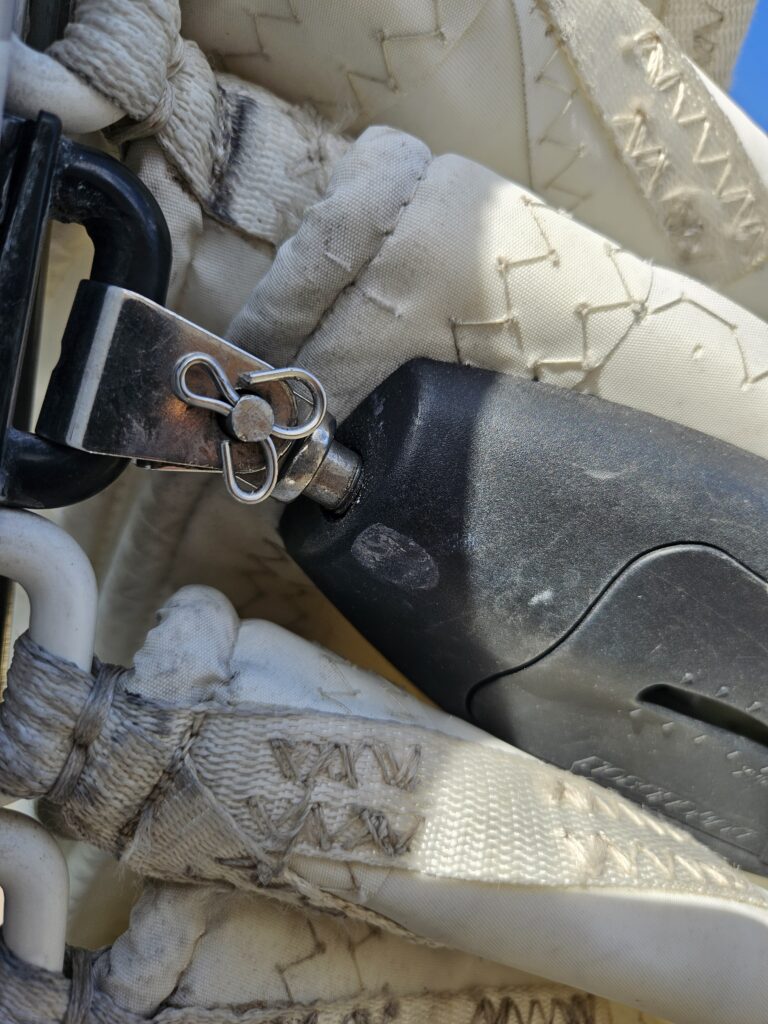
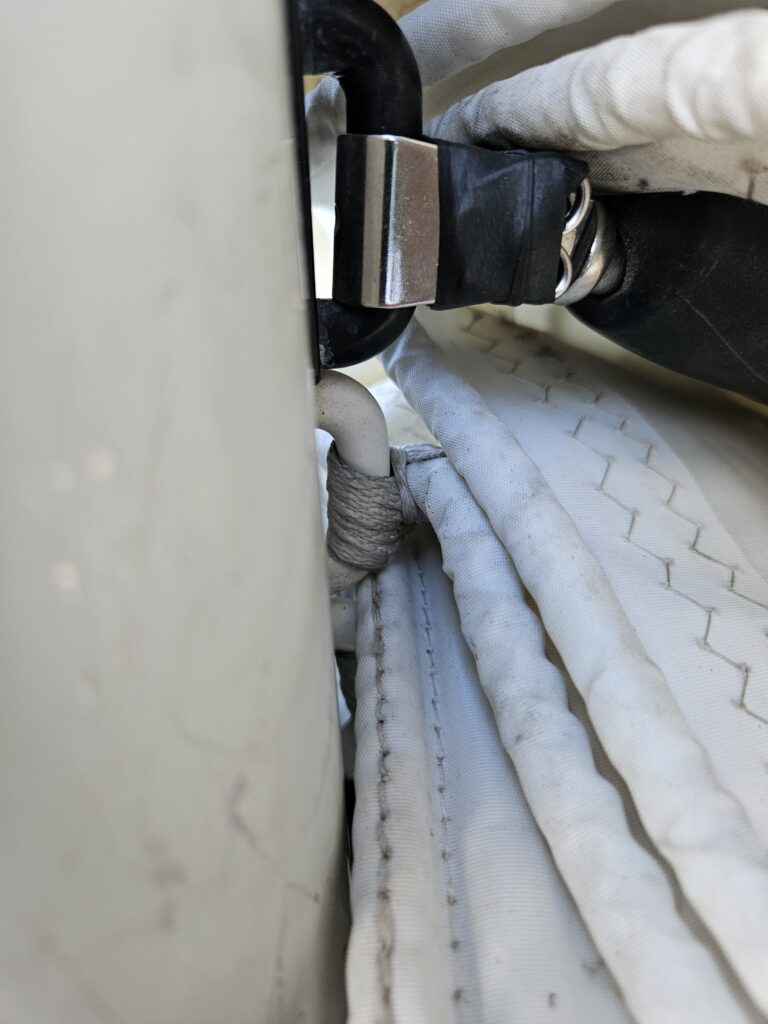
Side note on the sail repairs: a couple of years ago we had Jerry Latell and Justin Ailsworth of Evolution Sails, Deltaville, make a new mainsail for Canto. We’ve been very happy with it, but on this trip, strangely (and as already noted) the cotter rings were going missing from the sail slide shackle clevis pins on the full-batten slides. Jerry and Justin had new parts – they included two complete shackle assemblies and a set of new cotter pins (not rings) – shipped to Safe Harbor Marina Bay in Quincy, and they arrived the day after we did, allowing us to make the necessary sail repairs and improvements. Kudos/shout-out to Jerry and Justin at Evolution in Deltaville!
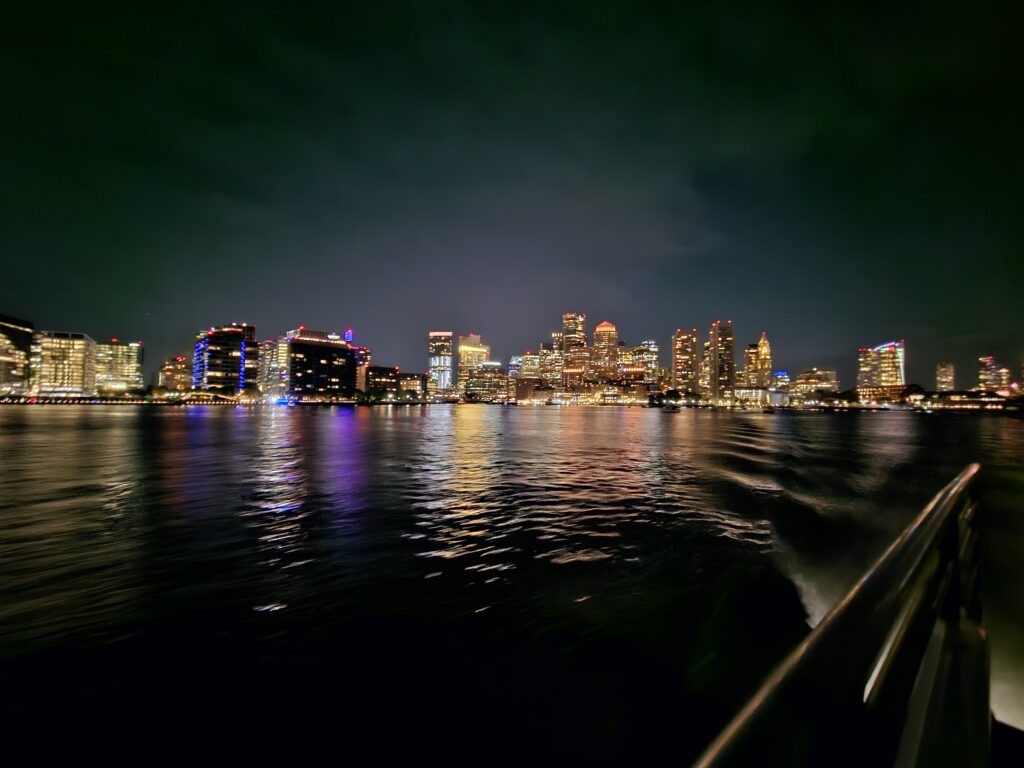
Safe Harbor at Marina Bay (Quincy) is a great place from which to visit Boston, as Boston is a 20 minute ($7) ferry ride away, and the ferry terminal is a 2 to 5 minute walk from the marina. We unpack our folding bikes and take the ferry to Boston’s Aquarium pier. From here, we visit the MFABoston and spend the day there after doing the guided “Highlights Tour.” This museum is well worth the visit and a day is hardly enough to see it all.
There’s always something fun going on in a big city like Boston. We just happened onto the Great Elephant Migration public art exhibit as we were riding our folding bikes to the MFABoston. Follow the link to learn more.

It is in Boston that we have one of the best Italian meals ever, at “Casarecce Ristorante“, which is open air, and from which we had front-row streets to a parade/procession that came by to celebrate Santa Lucia and kick off the Feast of Saint Anthony. We are on the last ferry back to Quincy (20:20?).
We stay one extra day (at our expense) to visit with an old friend (Julie Cooper). We end up only having a long dinner together but it is good to catch up.
Boston, MA to Northport, NY
The next few days are a bit of a whirlwind, as the weather is forecast to be great for a few days of westing, and we decide to make the most of it.
We hop from Boston to Warren Cove in Plymouth. Great and fast sail down with a brisk NW wind on our quarter. The wind lays down and goes easterly late in the day, so we can anchor in Warren Cove (instead of going into costly Plymouth). The anchorage is still very rolly as we drift to sleep from the northwest wind that’s been blowing all day, but is calm and quiet in the morning as the wind has clocked south. At the exclusive resort hotel on-shore, a band (“J Place and the Rockers”) is playing, and they’re very good! We enjoy listening to them as we settle in and prepare for bed.
Next day, we have good wind to close-reach to the Cape Cod Canal, make it to the entrance right on time, and transit the canal quickly, aiming to take a ball in Onset for the night. We decide not to go past Onset this evening because the wind forecast is for moderate southwesterly winds that afternoon and evening. And wow – we approach the northeast end of Buzzard’s Bay with about 5 knots of current behind us, all dumping into Buzzard’s Bay. And there’s a 25 knot wind funneling up from Buzzards. It’s a real washing machine, with 2-3ft rollers and strong wind right on the nose! We cut around the entrance marker into Onset and are almost spun around by the current, at one point pointing directly at the riprap on the marker! More engine thrust gets us out of this predicament and we are greatly relieved when we putter into the blissfully quiet Onset bay! We recommend approaching Onset at slack, or at least give the riprap marker a wide berth and with full steam! We also recommend not trying to go southwest on Buzzard’s Bay in a strong southwesterly. We don’t know why some mariners pressed on, but speculate that perhaps they are motivated by expensive marina assignations and exceeded cancellation deadlines.
In the morning, the wind has gone north, and to catch slackwater at the aforementioned Onset riprap marker, we leave at 04:30, in pitch blackness. Speaking from experience, we do not recommend picking ones way out of Onset in the dark, via the circuitous and narrow channel. We make it without any drama or suspense using a Q-beam to highlight the markers and look for wayward flotsam. As predicted and anticipated, the current is slack at the riprap marker, and we find a delightful breeze down Buzzard’s as the day breaks.
This day, we have the aggressive (for us) goal of bypassing Newport and reaching Point Judith – again, trying to maximize utilization of the westing weather while it exists. To get through the cut around Watch Hill with favorable current, we need to depart Point Judith at 9am in the morning on the next day – so says Eldridge, and he’s not been wrong yet as far as we know. We would have had to depart Newport at around 6am to achieve the same outcome.
We have a great sail all the way from Onset to Point Judith, only restarting the engine again to muscle-in past the breakwater against contrary current. We anchor – one can anchor just about anywhere – and settle down in the cockpit to rest a bit – it’s a long sail from Onset to Point Judith.
Point Judith makes a superb stopover for staging for westing through the Sound, but we would recommend going into Newport if winds over 25kts are expected from any wind direction having any south in it. If you’re forced into doing that anyway, at least rest assured that you’re protected from ocean swell, and the holding is excellent. The breakwater, however, is kind of low, and it’s not hard to imagine a large swell rolling right over it at high tide.
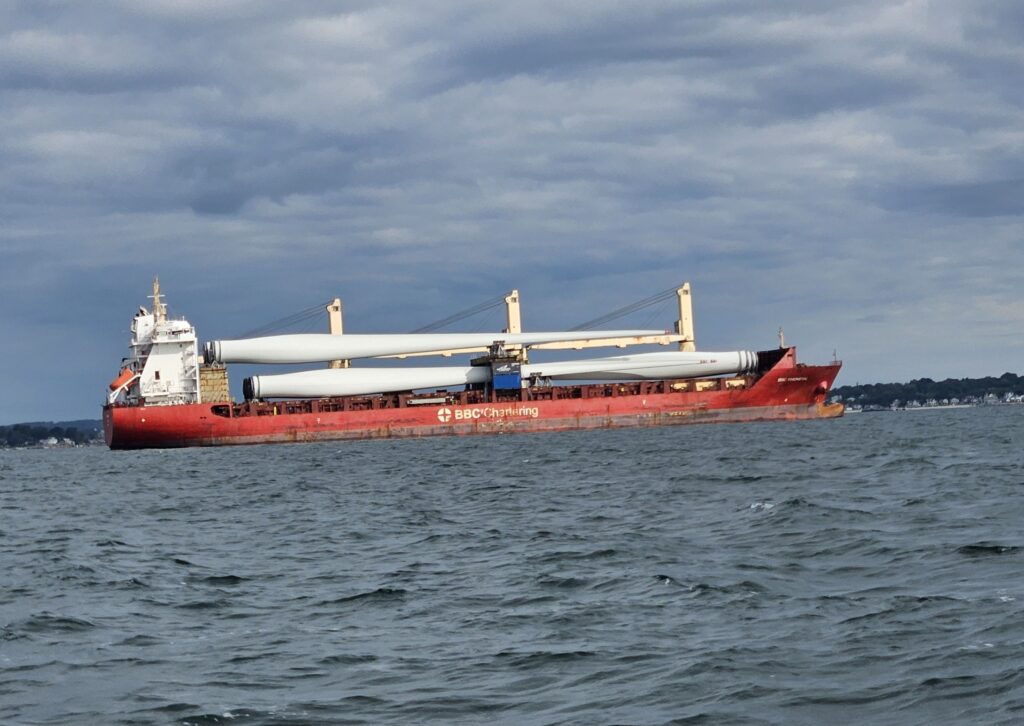
A wind farm (“Revolution Wind“) is being built off of Rhode Island (it was being built up to 2026, then stopped by the Trump administration in December 2025, then re-enabled by a federal court, and is now nearly completed). On a clear night, from the Harbor of Refuge at Point Judith, one can see all of the towers (some 65 of them) winking their red lights on and off in perfect synchrony – it’s a strange sight. Later, as we sail up the Long Island Sound, we pass an anchored ship with turbine blades loaded on its deck. This ship will deliver the blades to New London; then, another ship (i.e. the Wind Scylla) will pick the blades up, run them out to the wind farm, and install them on the turbine towers.
At 9am in the morning – a leisurely morning for us – we up-anchor and head to Fisher’s Island, trying to outrun a blow. The day starts nicely enough, but it’s raining by the time we wash through Watch Hill with the powerful flood current. Angie reads up on tuning the RADAR for rain (FTC, etc). The predicted blow comes a few hours early, before we’ve gotten to Fisher’s West Anchorage, but when it arrives, it is at least from the right direction, we’ve already entered the relatively protected Long Island Sound (through Watch Hill) and we are already under the lee of Fisher’s Island’s east end, so we’re in good shape. Still, we have a rather rocky night as the wind increases to 25 and tries to get to NE to find us. At one point, we have 2 ft rollers coming into our anchorage overnight. But by morning, it has settled to about 15 and with enough east in it that the little bay we’re in is quiet.
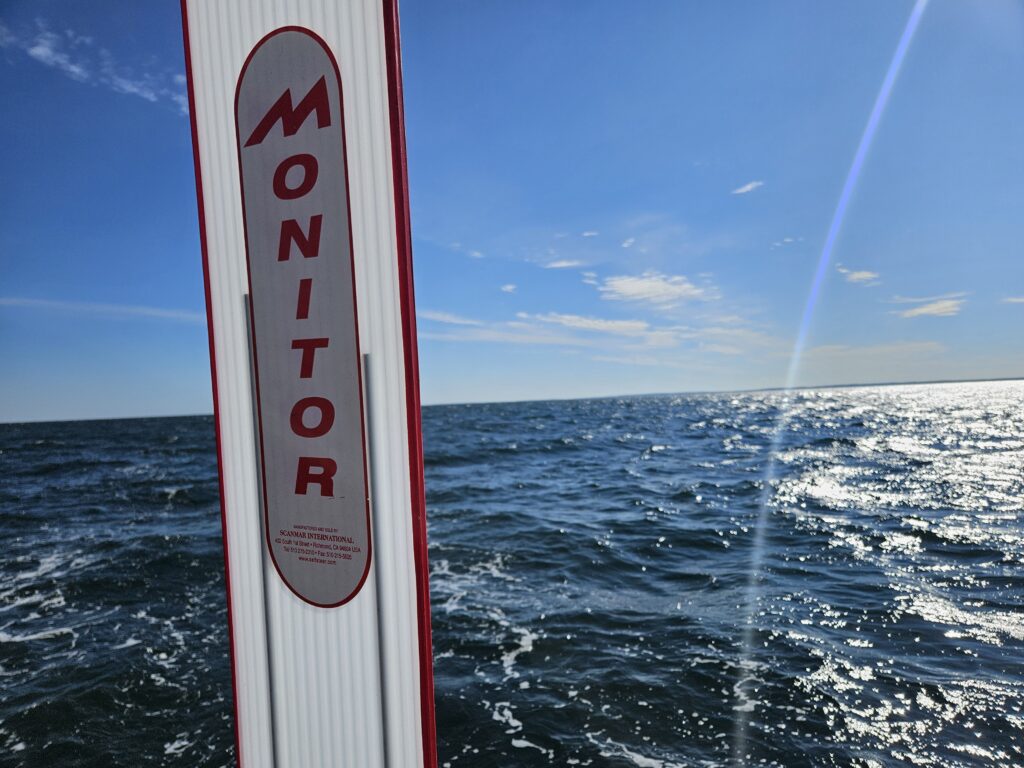
Because the autopilot does draw some power in a quartering sea, we hook up the Monitor (which actually likes sporty weather) and have a fabulous sail all the way to Port Jefferson, hitting 7 to 7.5 knots a lot of the way, and Monty keeping us right on the rhumb line without asking for any power. Without the autopilot load and with minimal clouds, the solar has our batteries at 100% by the time we reach Port Jeff.
In Port Jefferson, before going ashore, the skipper decides it’s time to clear the holding tank vent, which has been acting suspiciously. In removing and elbow from the tank vent, the tank vent breaks. Perhaps fortunately, the vent is indeed completely clogged (so, the odor of Holding Tank does not permeate the cabin). Ahhh… Cruising! Thankfully, the skipper did not initiate this maintenance in, like, Hurricane Sound or Matinicus in Maine!
We find a new part in a West Marine at the other side of the island, and we same-day ship it to Port Jefferson Yacht Club. All seems good, so we head ashore.
We have the vegetable sandwich at Locals Cafe (highly recommended!) when we come ashore, and before going on a parts expedition. Locals is a two-thumbs up!
Some problems with our same-daying a part from West Marine:
- West Marine’s courier is unable to find a driver, and it takes 3 calls to customer service before they can find one; meanwhile we are stuck waiting at a fork in the road to Port Jefferson Yacht Club (from 4pm to 8pm) because…
- Port Jefferson Yacht Club‘s destination for packages is NOT at the conspicuous club building prominently labeled “Port Jefferson Yacht Club”, but rather at a demur white shed referred to as, but not labeled as, the “Launch House”, located at the end of a dodgy looking gravel parking lot, behind a fence that says, “Members Only Beyond This Point.” We are told by the PJYC launch driver that things delivered to the yacht club building disappear frequently, never to be seen again.
- Through-hulls are sized by the diameter of the hole through which liquids flow, not by the threads. Skipper measured the latter.
In an abundance of caution (we thought at the time), we walk to Harborside Marine, which has a fitting hanging on the wall that looks like it could work. It’s about $7 so we buy it as insurance.
While we wait, Port Jefferson puts on a free concert in the adjacent park, so our wait for the courier was from the comfort of the yacht club balcony while listening to live music!
The courier finally arrives at almost 8, so we hurry back to Canto to install it. We immediately discover the 1″ through-hull will not work – it’s too big. The part that broke off has a 1″ thread diameter. So, we had ordered a 1″ through hull to replace it. It turns out, it’s a 3/4″ through hull, which has a 1″ diameter thread. Very fortunately, the $7 part we bought from Harborside as “insurance” will work, and spend until 10:30pm installing that.
This is the side of cruising that all cruisers know exist but about which you’ll find no words in a sales brochure.
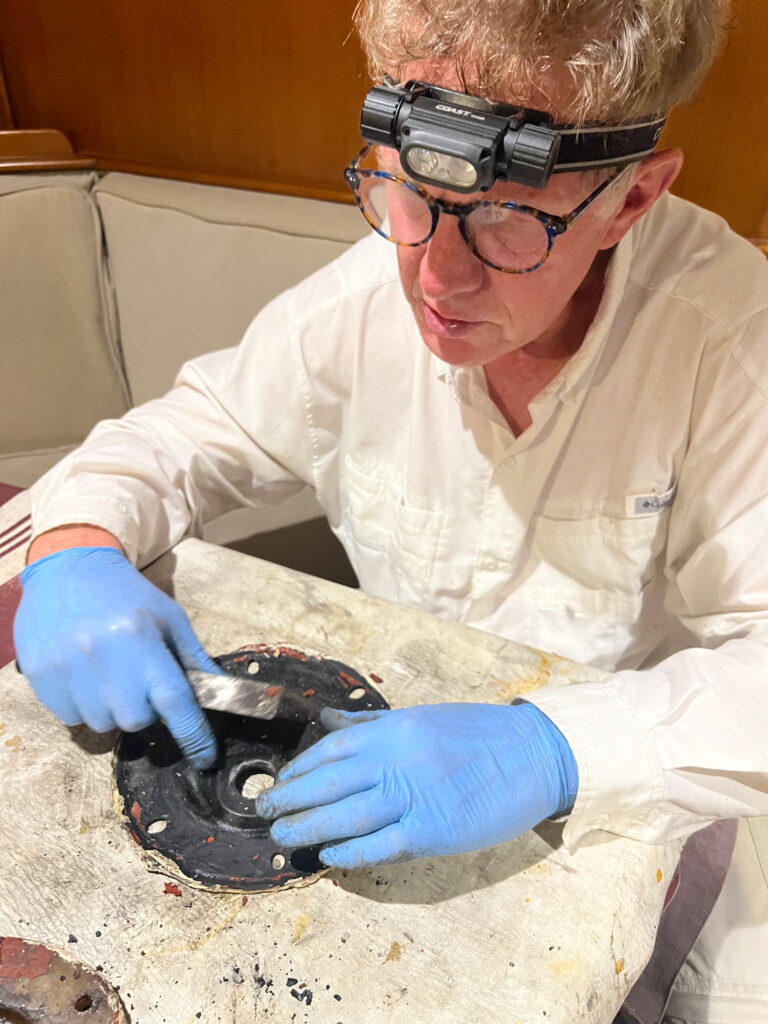
The new solution seems to gruntle the holding tank and shipboard morale improves.
Retrospective: When in Port Jefferson, we would advise finding business other than PJYC to which to ship parts. Harborside Marine would be a great choice. Also (should have known this): 1″ through hull has a one inch hole through which the fluid passes; 1″ does NOT refer the diameter of the hole you drill in your hull (or holding tank) to accommodate the fitting. In our case, we were after a 3/4″ through hull, which requires a 1 1/16″ hole and has 1″ thread diameter.
Port Jefferson to Northport
We decide to make Northport on Huntington Bay our next stop. Having never been here before, we apply for a mooring. Unfortunately, the Center Yacht Club is full up due to Labor Day; fortunately, Seymour Marina has a mooring, but only for one night.
We sail from Port Jeff to Northport, sailing all but the last 50 yards to our mooring (and the last 50 was motored because our mooring was 50 yards upwind of where we thought it would be, in a crowded mooring field).
A mooring in Northport is advisable if you get around on a rowboat – the rowing distances are very long otherwise (like, 2 miles). On the other hand, with folding bikes, one might anchor near a ramp, land a couple of bikes, and ride into town. We didn’t try, but looks very feasible. If we come this way again, we may try this approach, as anchoring here is quite easy, and the bottom is grippy.
In town, we visit Dortoni’s Bakery – not to be missed for their sourdough bread! Northport has a very nice waterfront park, with the prevailing wind keeping it breezy, and large deep-shade trees covering most of the park. This is a great place to people-watch. Bring dog treats.
On Saturdays, there’s a Farmer’s Market. We come back to shore for this, and buy a bunch of freshies. But just because it’s straight from the farmer doesn’t mean it’s less expensive – perhaps the opposite. This is not a cheap way to get freshies and baked goods. Also, no eggs.
We cast off and motor 1.5 miles to anchor in “Price Bend” off of Eaton’s Neck, still in Huntington Harbor. This anchorage has great holding, very nice beaches, 75 degree water.
The Skipper decides to clean the bottom and prop. It’s successful, but it’s hard going due to the heavy Labor Day Weekend boat wakes – it seems every skipper who has purchased an expensive power boat must demonstrate the size of his manhood via the metaphor of his wake. It’s like cleaning the bottom at sea. However, this skipper is highly motivated due to the thick layer of algae which is thriving on Canto’s bottom. A scraper takes it off, but it takes over an hour to get the entire hull mostly clean. By the end, the skipper is quite ready for some relaxation.
In contrast to the wind turbines off of Rhode Island, this harbor’s scenery features the Northport Power Plant.
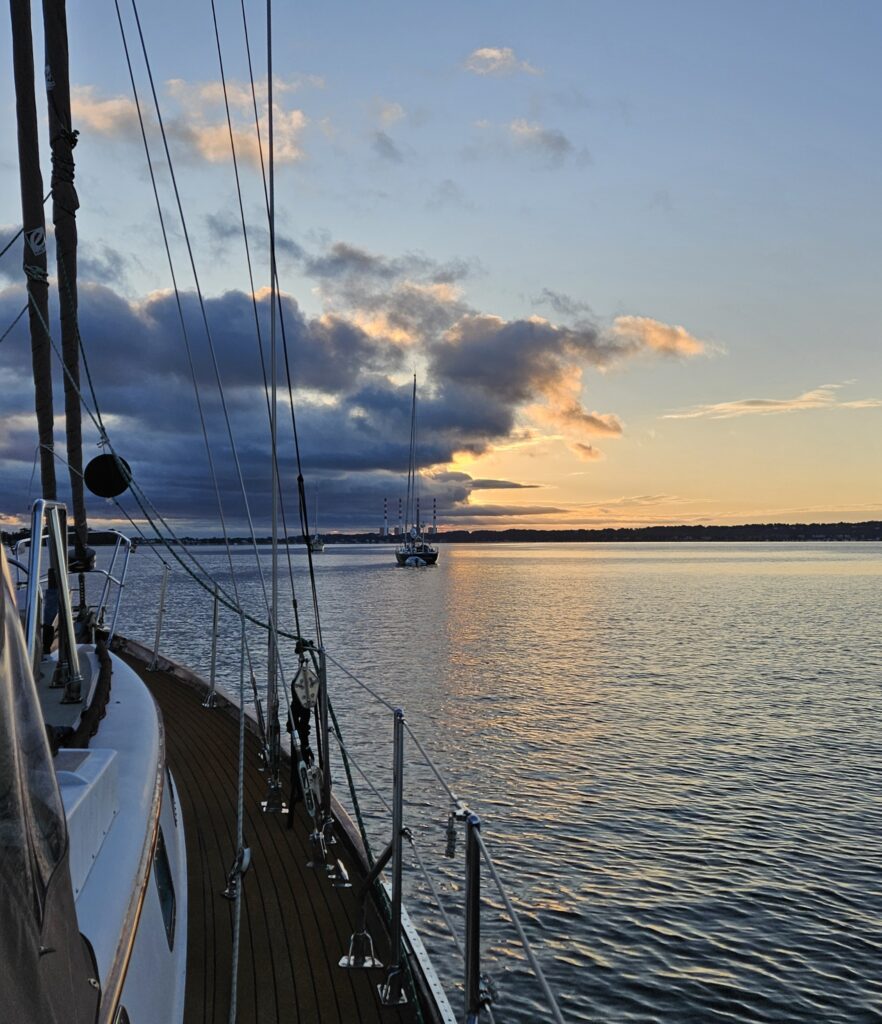
These stacks can be seen for miles and miles; in fact, you can see them from Long Island Sound at Port Jefferson. When they all line up as you near Huntington Bay, they look like a single stack (Piloting Note: and at that point, you have a line of position on your paper chart)! Instead of harnessing today’s wind, these stacks vent the unwanted and environmentally detrimental byproducts of energy stored in and released from molecules built over millions of years by heating and pressing ancient dead plants and animals,
Huntington Bay is a delightful stop-over. It’s expensive if you must take a mooring. If you DO need a mooring, we recommend the Center Yacht Club, which has better shoreside amenities.
All said, one can readily find free anchoring with good holding and protection from most wind directions in Huntington Bay. This is well worth a stopover if you have the time or need a nice place to sit-out weather.