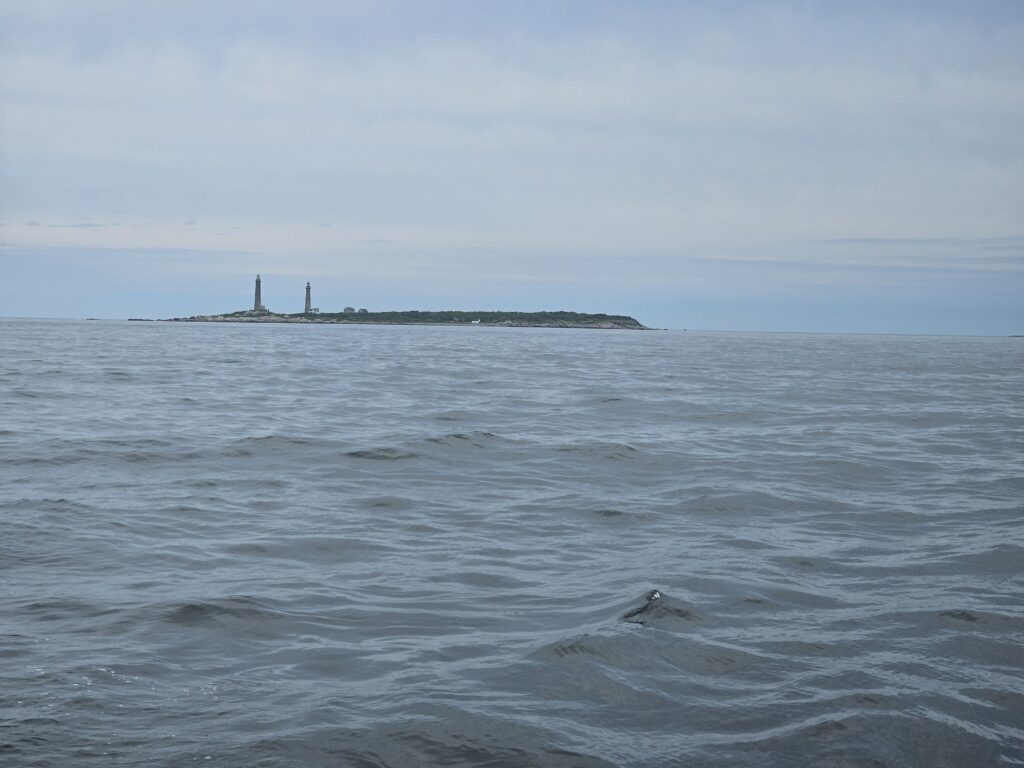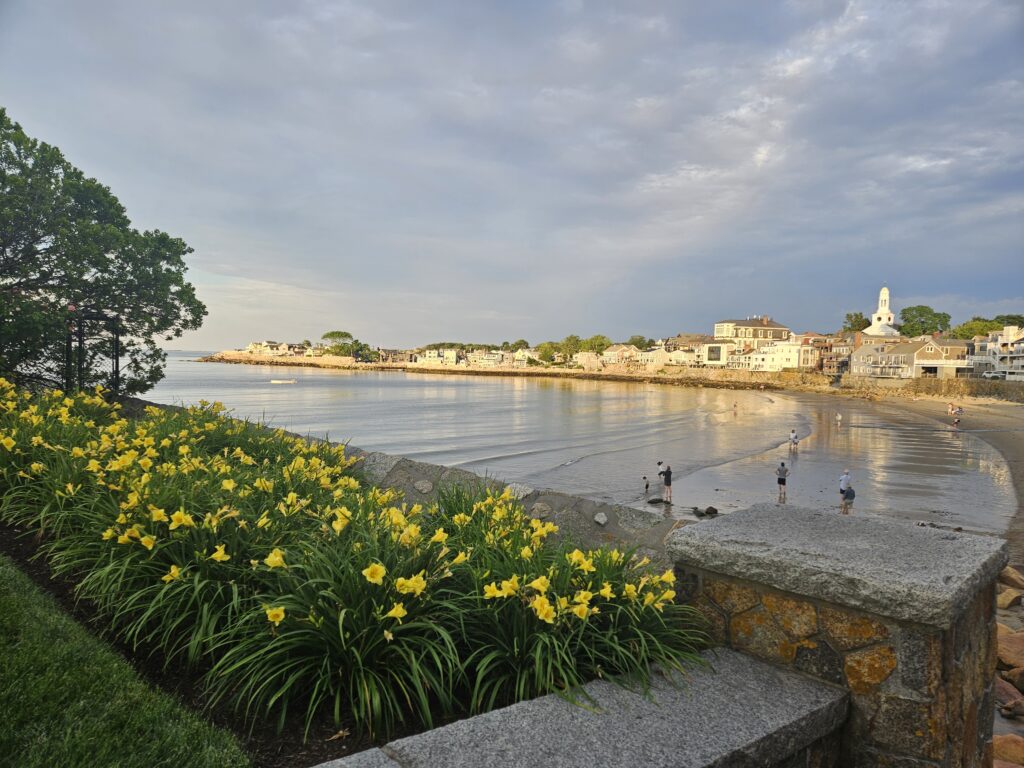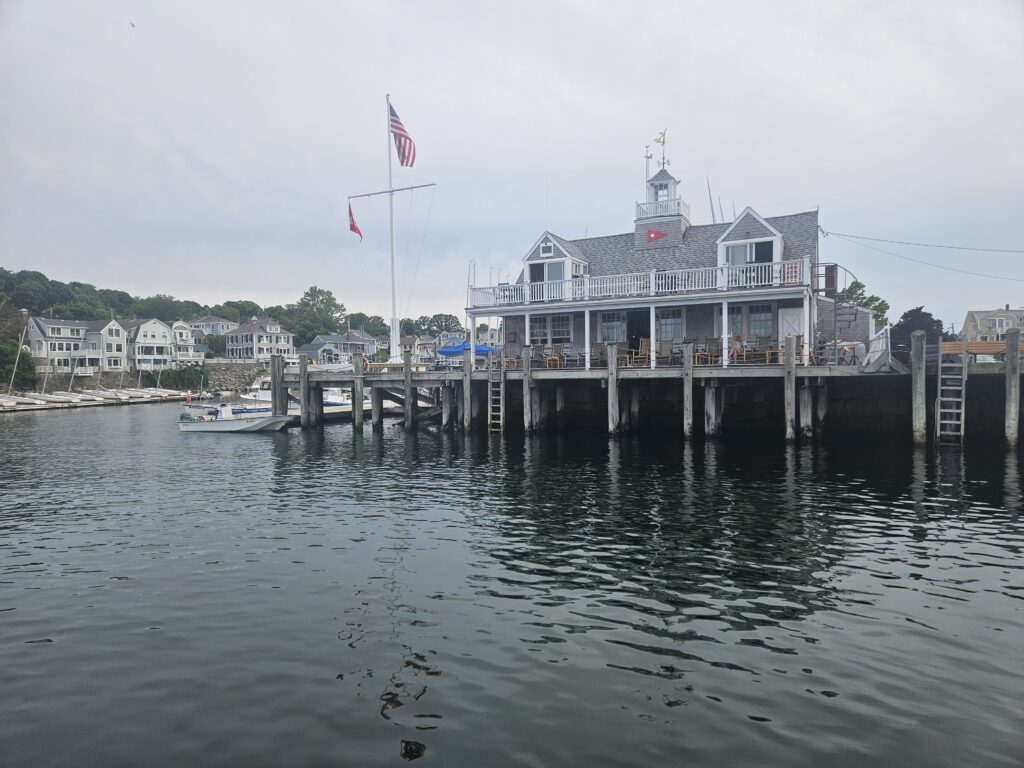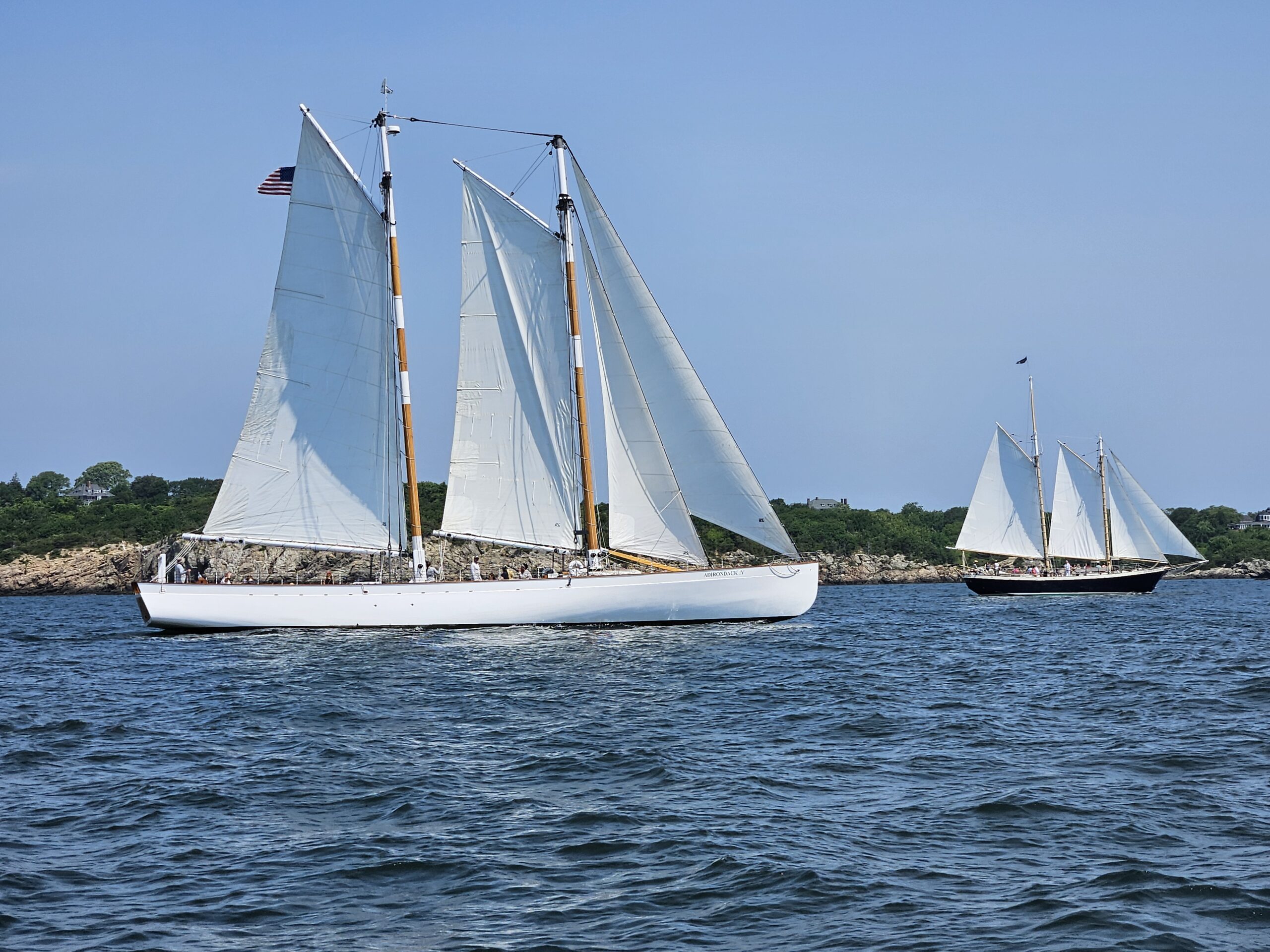
We leave Block Island at a time when the ebb from Long Island Sound will still push us a little towards Newport. Wind is light, but we’re not in a big hurry, so we waft along towards Narragansett Bay, sailing all the way into the mooring field by Ida Lewis Yacht Club. We do not sail fast on this trip, but we save some fuel and manage to make it into Narragansett Bay during the flood there.
Ida Lewis Yacht Club  is in an ideal location, near the Fort Adams State Park, and in a location that allows observation of everyone coming and going while not being in the middle of it.
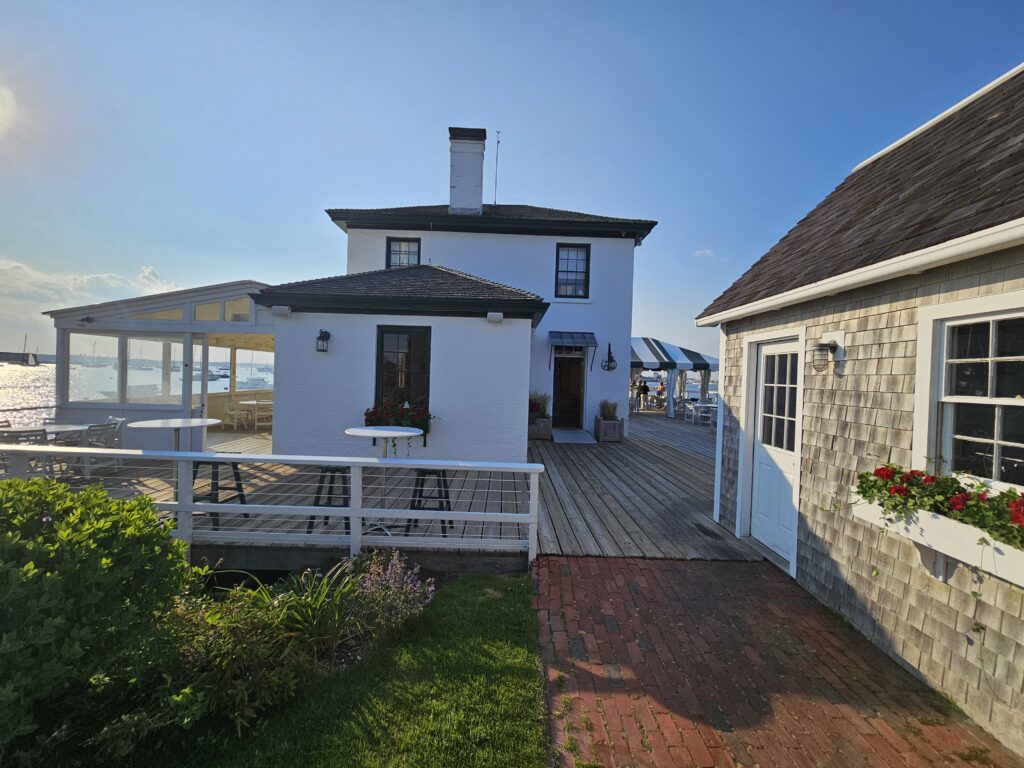
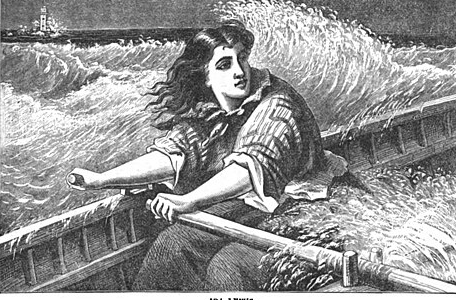
The yacht club is named after Ida Lewis, a female American lighthouse keeper, credited with saving many lives from the sea.
The club has a beautiful clubhouse, with a spacious deck overlooking Newport Harbor and with splendid views of the sunsets, and a well-stocked bar and super-friendly bartender (“Blendi” from Kosovo). There’s no food, but Mother’s makes really good pizza and will deliver to Ida Lewis. Blendi makes very tasty G&Ts.
Also to-do in Newport: time for our oil change. So, we do the change, and ultimately discover that Oldport Marine Services will take old oil for $2/gallon (June 2026). The auto parts stores are near a bus line, so we trek to Autozone and a nearby supermarket to restock oil, filter, and groceries. The bus stop is a good walk from Ida Lewis, so on the return trip, laden with groceries, we hire an Uber to drop us at Ida Lewis from the grocery store. As a note, Oldport Marine Services operates a water taxi (quite reasonable, I hear) and drops off at the Oldport Marine pier. This pier is actually pretty close to the bus stop, so, you could take the water taxi to nearby the bus stop, then the bus to the supermarket, etc. Still, for getting back, Uber was the move. $17 for two people, a ton of groceries, door-to-door service.
Also on the chore list: get water, get fuel. All are accomplished without incident*, and we’re bushed. *Well, there are two mega-yachts at the Newport Yachting Center when we arrive for fuel and water – we’ve always gone there – so there is no room to dock. We wait around for 10 minutes or so but to no avail, so end up going to Barrister’s Wharf for both. Which turns out fine.
We do all our chores (except laundry) in Newport but don’t intend to linger, so as soon as the weather allows, we cast off and head up Buzzard’s Bay to Onset, MA.
Fantastic sail to Onset. We motor a total of one hour this 45+ mile day – half an hour of safety idling as we sail off of our mooring in Newport (keeping the engine on in case an Optimist suddenly thrusts itself into our path, or in case we get a gust as we’re pointed at an America’s Cup boat, etc.) and then an hour at Onset to drive the boat into Onset Bay, with all the twists, turns, shallows, and powerful currents. This last concern is especially unnerving – it’s getting dark (we had a nice sail up Buzzard’s Bay, but the run from Newport is long) and the current is running fair at 4 knots as we head up the canal to the Onset turn-out! So, we had to turn out of that into the channel to Onset, necessitating crossing a sporty rip WHILE the Monhegan (a large ex-ferry head boat) was coming out. We have to point Canto’s bow so that it looks like we are going to cross Monhegan’s bow to account for the now-cross current. The captain of the Monhegan understands and gives us plenty of room, so there is no panic.
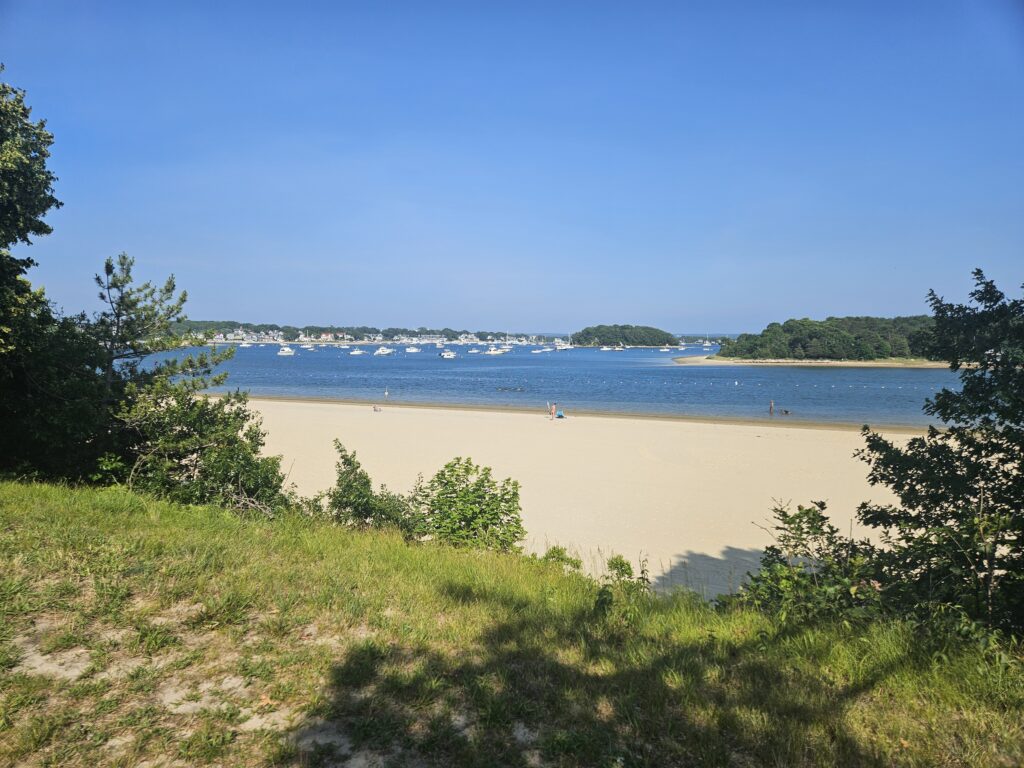
We are assigned a mooring – the most reasonable ones so far (the price also includes a launch) and sigh a breath of relief. The next day, winds are predicted to hit 30kts, so we’re very happy to be safe and secure in quiet, tranquil Onset Bay! NOTE there seemed to be plenty of room to anchor at Onset. We elect to use a mooring for our convenience and the charm, but coming in and dropping a hook seems easy. In that case, Safe Harbor is nearby and you could probably leave a dinghy there to go to town.
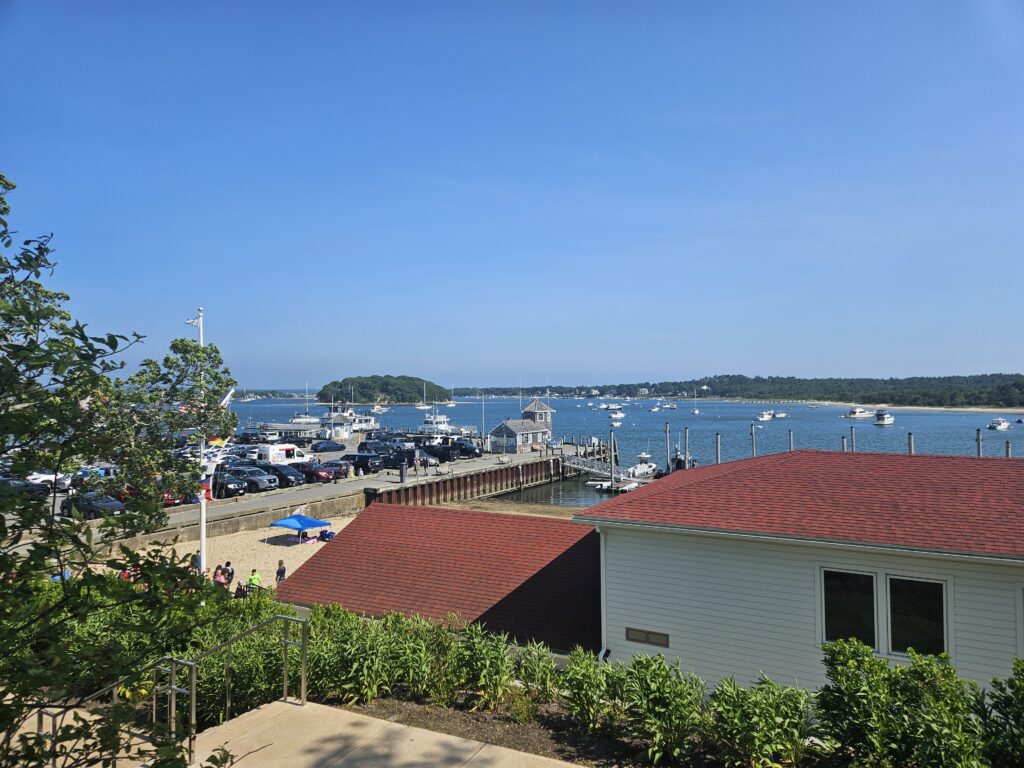
In Onset, we decide to have another try with our folding bikes. So, we load them into the dinghy. An aside: we actually didn’t know yet that the launch was included in the mooring fee; we discover this later and employ the launch on the return trip to ferry the bikes back – Adrian returns to shore to get the rowboat. By now, it’s blowing over 20 and so rowing two people and two bikes across even Onset Bay was a daunting prospect. Anyway, we set up the bikes, and then make our way over to the Cape Cod Canal Trail to ride it.
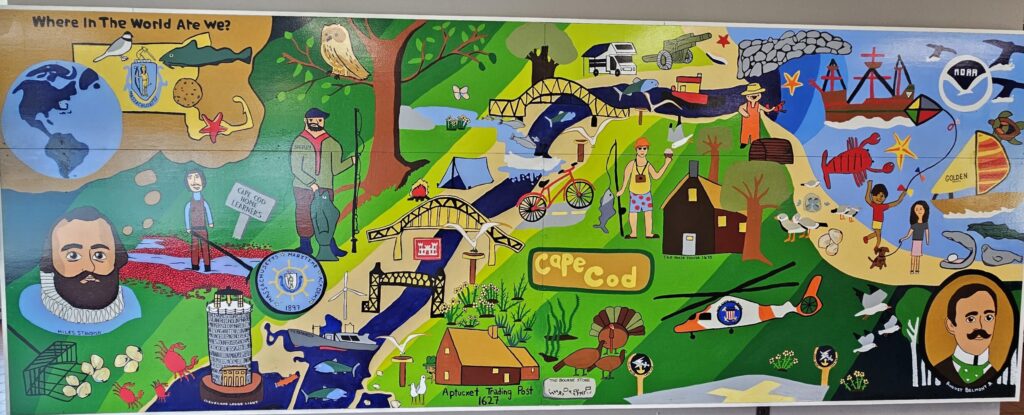
We have lunch at the Seafood Shanty, which is along the trail, and decide to head back – we have some stiff (30kt) headwinds to battle on the return trip, so the return trip takes longer and requires more effort. The lobster roll at the Seafood Shanty is packed with lobster, and is fantastic. And with a great view of the Canal.
Having folding bikes, while they’re a pain to lug around, provides a lot of flexibility. A 5 or even 10 mile trip is quite viable on a folding bike (provided there’s some cycling infrastructure). We spent some time before the trip making the bikes roadworthy, and we invested in a couple of bike carry bags that just fit the folding bikes, so they’re easier to lug around and can be stuffed side-by-side into our starboard quarter berth without damaging anything or getting dirt in our boat. They snuggle in there pretty closely, so they don’t rattle around in a seaway, especially when wedged in with yoga mats. Aside from landing Angie in the hospital in Solomon’s (not really the bike’s fault), the bikes have been nice to have onboard so far.
We leave Onset with heavy hearts. We time the trip so that we can make the 7.5 miles of Canal with a fair current. Since we have the current fair, the transit will actually take less than an hour since we’re adding our boat speed to the current speed, adding to about 8 or 9 knots. Very soon, we’re in Sandwich and then out into Cape Cod Bay, headed towards Provincetown (“P-Town”). We had been expecting a fresh breeze air – 20 knots from the stern with accompanying lumps. We had even taken a pill against seasickness, but the canal dislodges us into, essentially, a mill pond. We are obliged to motor for a couple of hours, but soon enough, we see our anemometer register 5-6 knots across our boat from astern, we spy some ripples on the water, and we shut the engine off. It’s slow sailing, but P-Town has an easy entry so we are OK arriving late if we have to. Despite our fears, the wind continues to climb. We reef. Then it dies. We shake out the reef. Then it builds again. We reef again. We try reaching. We set the pole. We gybe. Reset the pole. We’re starting to consider reducing headsail when we arrive with enough daylight left to go to town. Almost immediately, we are treated to a New Orleans-style Jazz Band in the street, complete with brass, piano (!) and bluesy singer.
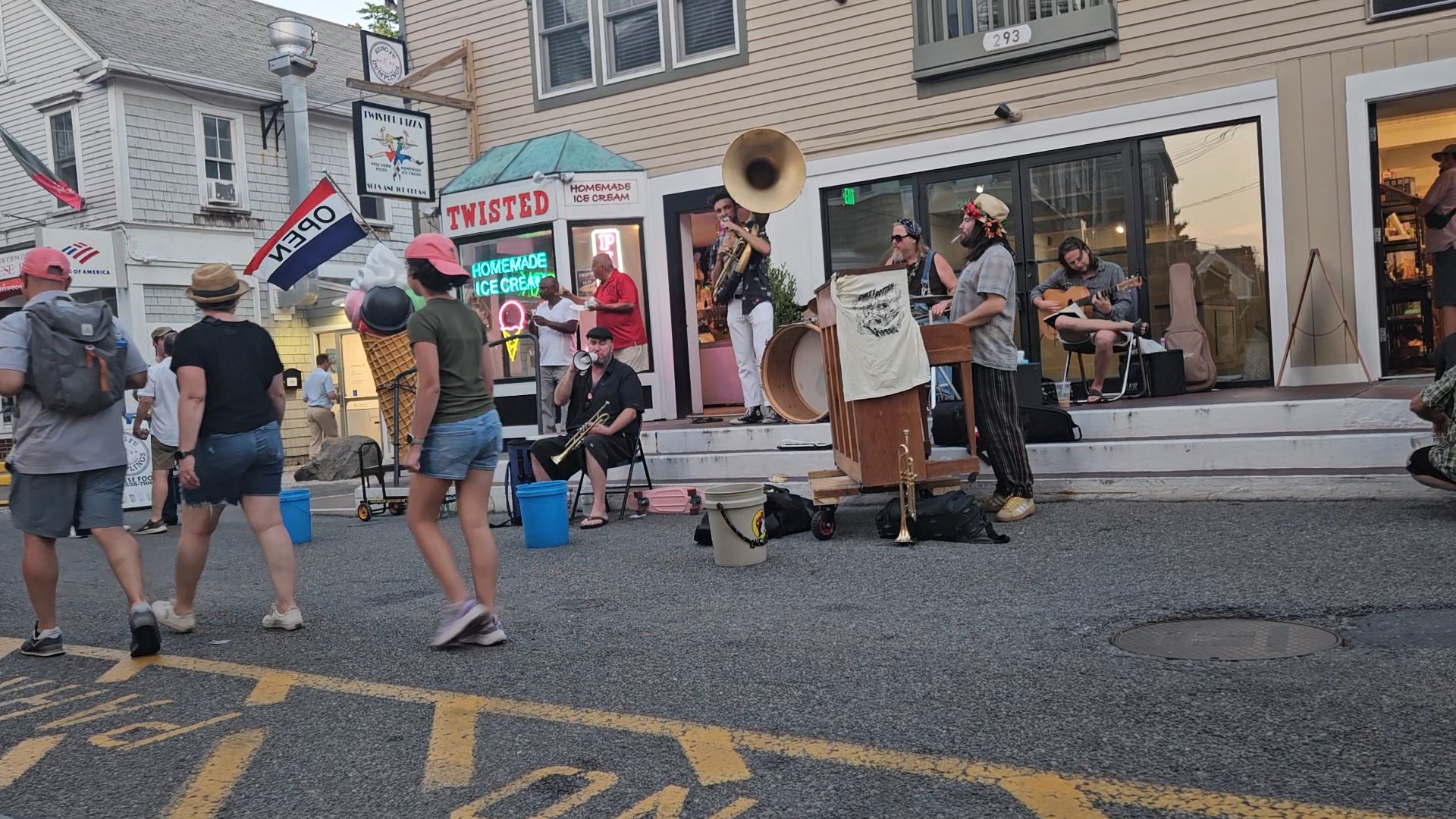
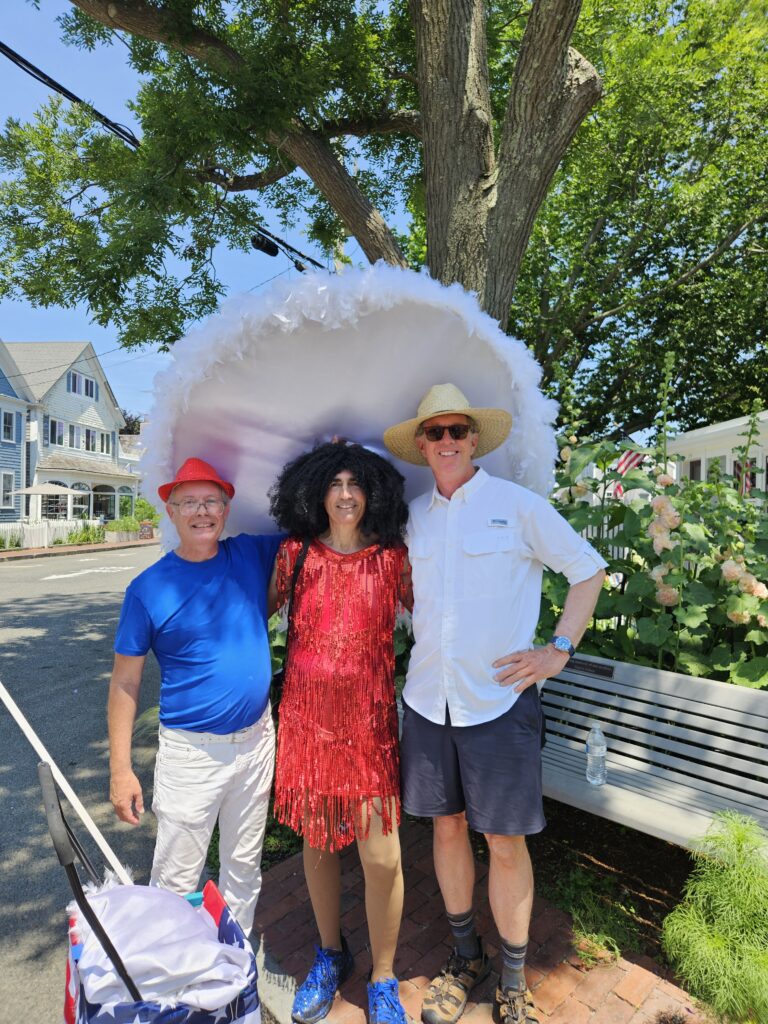
Provincetown is not a standard town. All sorts of flamboyant characters reside there. One thing’s certain: everyone is friendly. People make eye contact, say “hi” and are generally unreserved. The main drag there, Commercial Street, is one way for motorized traffic, but pedestrians, cyclists, rickshaws, go every which way. CAUTION: Do not go if you’re disturbed by banana hammocks or low-hanging fruit. This is a live-and-let-live kind of place.
Each day we’re at P-Town, we’re lured by a perfect breeze to go sailing in our dinghy; frustratingly, by the time we get 10 yards from Canto, the breeze dies and becomes still as a mirror. Sigh.
By far, the moorings in P-Town are the most expensive, costing 3 times what a mooring at Onset cost, so we do live it up for a couple of nights, do laundry, use the showers, and so on, but are eager to get off. We scope out a weather window and, the night before we leave, we go anchor out.
Anchoring in P-Town is easy as long as you have 300 ft of chain or more. All the shallow spots are occupied by moorings, moored houseboats, and so on. So, the best spot for Canto turned out to be a mile from shore, in 60 feet of water (at high tide). I’ve been the subject of some humor at our yacht club for carrying 400′ of chain; certainly, in the Chesapeake, this is overkill. However, in P-Town, we needed 240′ of chain to anchor in P-Town with adequate scope, and would have needed 100′ more had we expected any kind of weather = 350′. Considering the storms that have rolled through much of New England this July 4th, suddenly, having 400′ of chain available seems appropriate for this kind of trip.
Our departure from Provincetown to Rockport is not one to inspire peaceful, easy feelings. That night, we have 20-30kts from the east and then south, and we’re rocking all night. In the morning, it’s no kind of friendly weather: it’s cold, grey, and with winds from the south at 20kts. South 20 is good for going north, but we first have to make it around the south part of the cape, in full exposure to Cape Cod Bay. Canto’s a stout boat, so we each take a Stugeron 15 pill, put two reefs in the sail, rig the running backstays, and go for it. Another boat, having a more powerful engine than our Perks4108, powers into the 2-3′ chop, looking like an old Victory at Sea video. For Canto to escape Cape Cod, we have to sail, so we raise the double-reefed main, unfurl the staysail, bring her hard on the wind and beat out. Doing this, we don’t take the waves head-on, and aside from occasional spray, we make it out in relative comfort – with two reefs in, we don’t heel more than 20 degrees, and the current’s with us, so we make over 6 kts over ground. Once we round Wood End Light (the southern tip), we can bring the wind over our beam, then shoulder, and we’re flying!
But it was not to last. A couple hours later finds us motoring in light air. NOTE: during the last year or two, we had had problems with Canto’s motor running too hot in the Chesapeake. This past winter, we updated our electrical system to Lithium. I won’t bore you with the technical details (unless you ask), but let’s let it suffice to say that the resultant reduction of load on the alternator also reduced the load on the engine. On this trip, we ran at our normal RPM (2000RPM) for hours and never saw the engine rise about 180 deg F, even with the alternator sending 50A to the house bank to top it off. The theory is that the 15yo lead acid gels were over-taxing the engine via the alternator. (The other theory is that the 80+F water of the summer Chesapeake just doesn’t accept heat as efficiently as the 70F water here). Anyway, all is well so far on the electric and mechanical facet of Canto, and we’ve really been enjoying the LiFePo4 battery upgrade! We even run an electric pressure cooker for quick dinners!
On the way to Rockport, we cross Stellwagen bank. Suddenly, we see humpback whales all over the place. We get a good video of one flapping its tail at us.
Rockport is one of the destinations on our trip (not just a pass-through). The harbor here is extremely tight, but the town is delightfully charming. We tie up at one of the two floating docklets (two boats per dock) and enjoy the hospitality of the Sandy Bay Yacht Club.

We intend to wait here for another weather system to pass while we enjoy the town’s many charms. Before you know it, our plans have filled Wednesday up completely – orchestra, art gallery, yoga.
Rockport is very scenic, from the view over Back Beach to the fishing boats. It seems like all the restaurants have waterfront views! And it’s not overcrowded with tourists and cars. It is one of our favorite stops.