In Solomon’s we decide to visit the Calvert Cliffs, riding our new-to-us folding bikes. So, we load bikes, food, water, and people into our little rowboat and go ashore. It’s about 5 miles to Calvert Cliffs Park, and on a folding bike, that’s a trek. But we make it, only to have Angie go over the bars on a speed bump, landing her in a hospital. Alas, we had forgotten to pack our bike helmets, but thought, “Just this once…”. Anyway, she had a nasty (5 stitches) cut on her scalp, which bled profusely, but docs stitched her up and, after a scan to look for non-obvious damage, we were out of there by around 6pm. Zahnizers was kind enough to collect our bikes from the Calvert Cliffs park kiosk for us, so when we left the hospital, we just got a taxi (“Smart Ride” – fast, cheap, friendly) back to Zahnizers. This was not the adventure we set out to have, but it was adventure nonetheless. The fossils will have to wait for another day. At least neither of us became a fossil this day.
Leaving Solomon’s, we manage a nice, relaxing sail all the way up to Annapolis. This is slow going as the wind is light and contrary, and it takes us allll daaayyyy. At one point, we did have to crank the engine, but shut it down again after about 2 hours when the wind filled in again. But we arrive before nightfall and are able to sail right up to a vacant mooring.
Along the way, we passed Poplar Island to starboard. We learned this island is restricted access, but one can get a birding tour (free) at various times of the year. We think we’ll probably do that at some point. They drive you around in air-conditioned busses and stop here and there to view the birds. Sounds delightful!
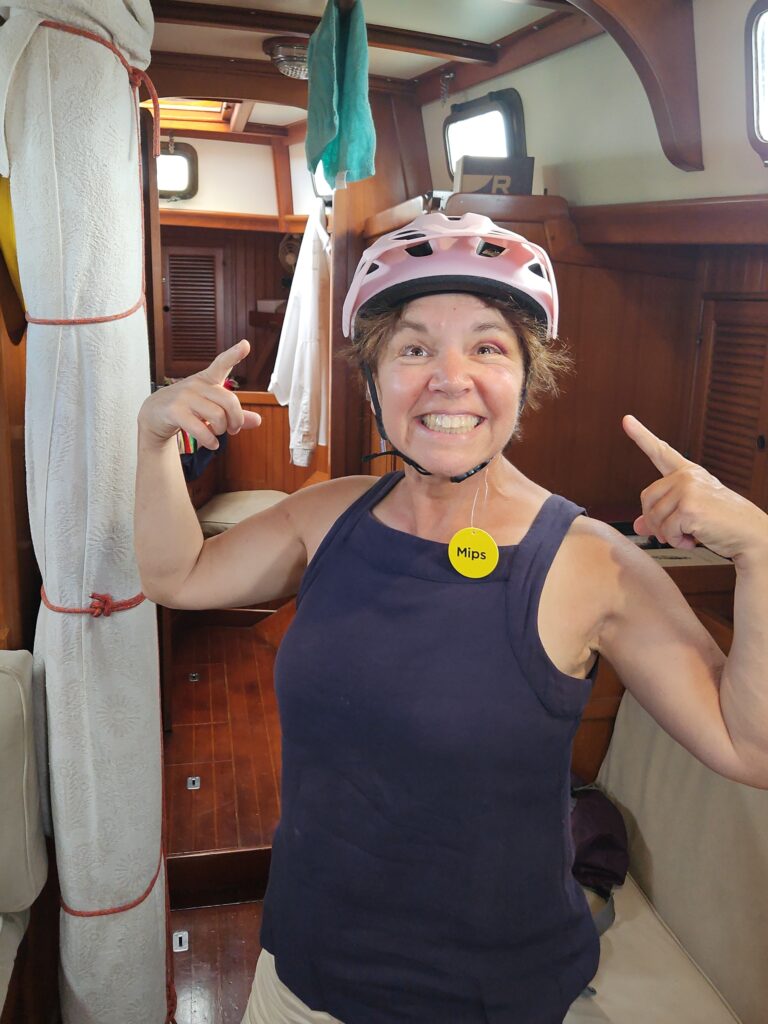
We spend two nights in Annapolis. We busy ourselves Monday using the public transit systems (plural) to get to Gateway Shopping Center to purchase helmets and some groceries.
In Annapolis, we start looking for weather windows to make it down the Delaware River and onward to Block Island. The weather is a little unusual this year, with the steady southwesterlies we are expecting reluctant to settle in. So, we eye a window that breaks the trip into multiple legs:
* Annapolis to Bohemia River
* Bohemia River to Reedy Island
* Reedy Island to Cape May (we end up stopping in Lewes because it’s easy to do in the dark)
* Cape May to Block Island
We leave Annapolis and have a fine sail up to the Bohemia. Holding in the Bohemia is fantastic, requiring a bit of engine horsepower to break loose once the chain is vertical. As Adrian is cleaning up, he leaves the anchor half on the roller, and a wavelet causes it to wiggle and jump off the gypsy. Chain starts stripping out of Canto faster than a scalded dog. About 150 feet escape in seconds before we are able to stop it and reengage it on the gypsy. First time this has happened in the nearly 30 years of owning this boat! We up-anchor again, and we’re on our way up the C&D canal.
On a slow boat, one cannot catch the ebb on the entire west-to-east trip down the Delaware (this is easy to accomplish when heading east-to-west), so we sneak behind Reedy Island (holding is excellent) and wait for the last two hours of flood before setting forth. Unfortunately, this happens around 4pm. So, at 1600 hours, we up-anchor. To keep out of the bulk of the waning flood, we head all the way down to the eastern end of the dike before entering the main body of the Delaware. One has to be careful to not cut across the dike, and to avoid the rock at the end of it, etc… But we have timed it well – we have maybe 1/2 knot of current against us when we enter the main waters, and soon it is with us. The wind is moderate to fresh from the southwest, and we are soon flying down the bay at over 9 knots, with a reefed main and thoughts of reefing the headsail.
We have opted to stop near the mouth of the Delaware because the forecast for a two-day run up the coast has near gale-force winds predicted along the way. We could do this, but it wouldn’t be pleasant, and we’re not in a big hurry, so we wait for a later window. We opt for Lewes this day because we’ll be arriving after midnight and Lewes is very easy to get into (as opposed to Cape May, where the anchorage is in current and often pretty full, and where the passage through the inlet should be timed for slack or favorable current).
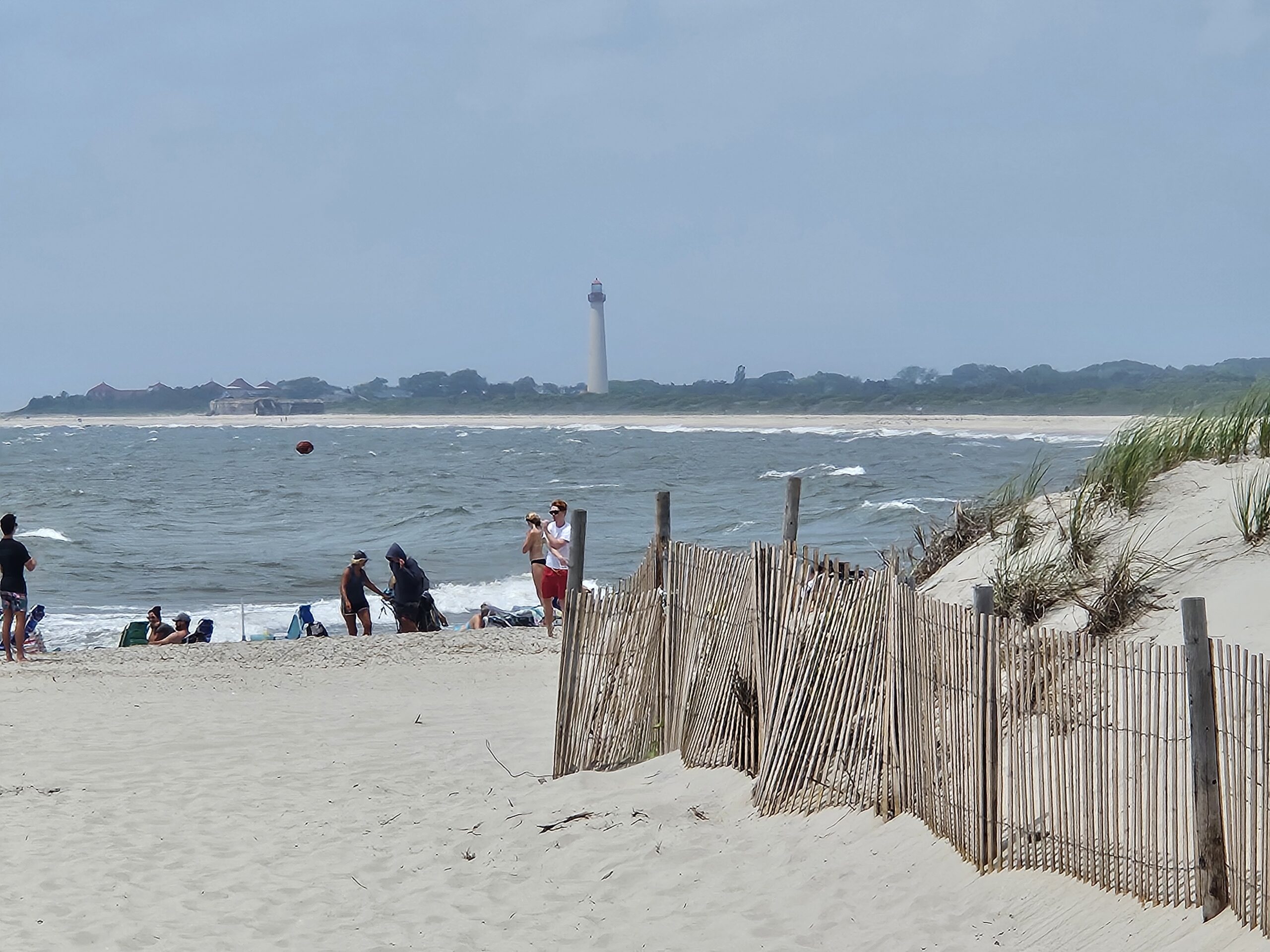
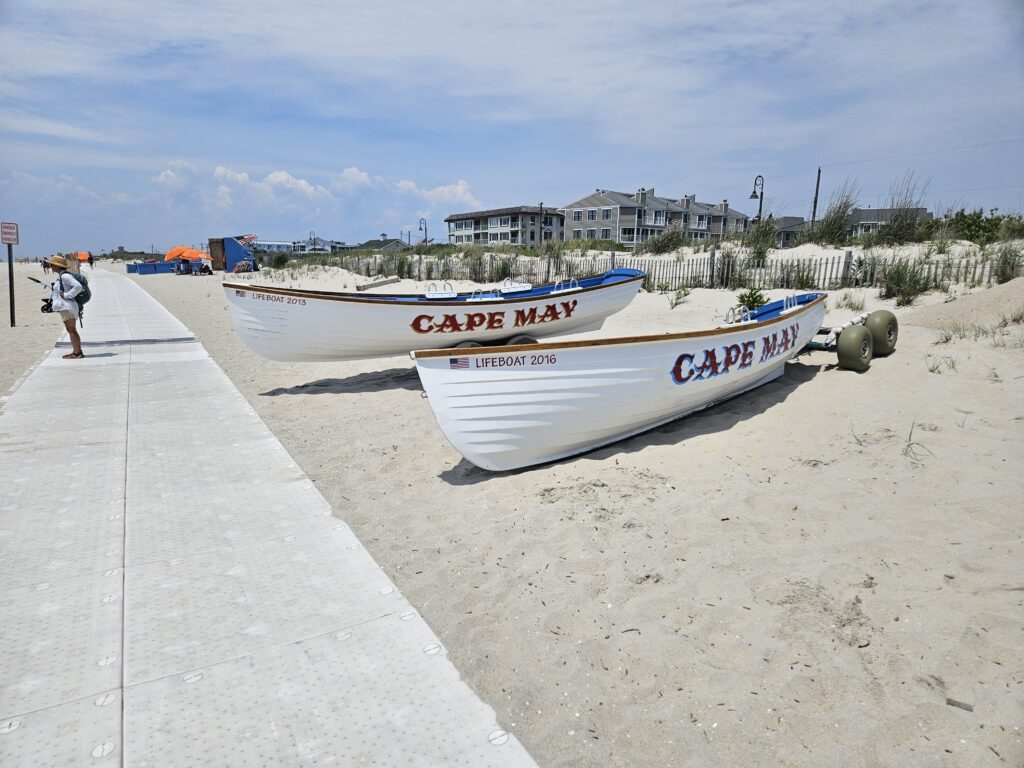
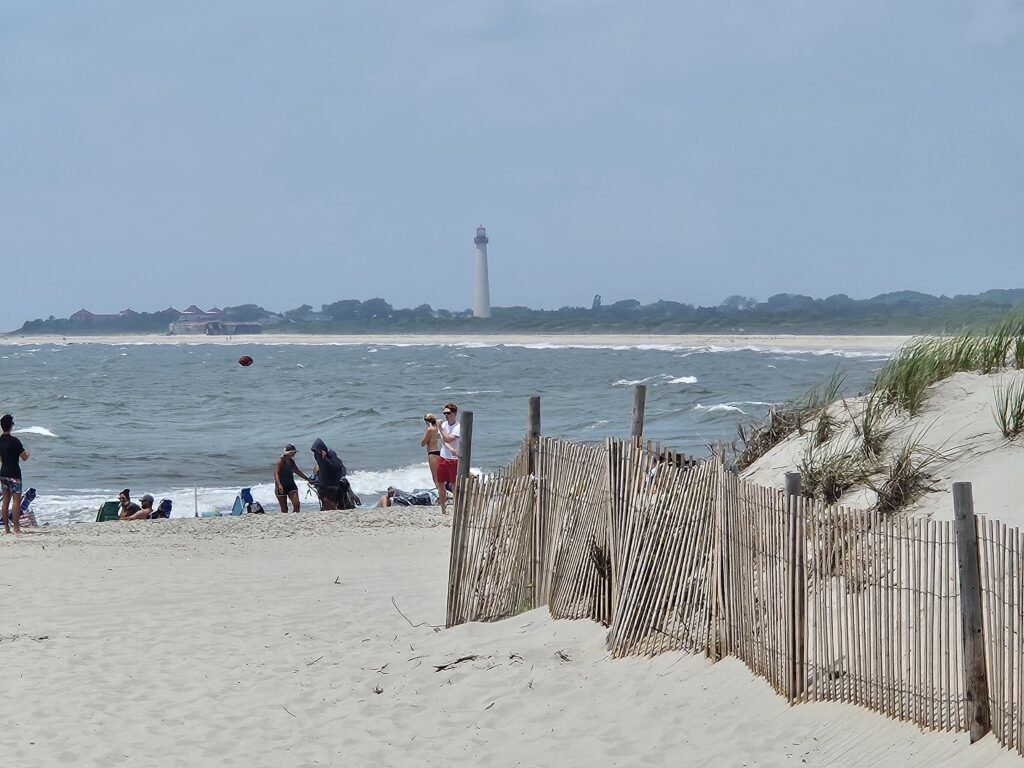
Next morning, after a good lie-in, we sail in light airs to Cape May, where, aided by broad daylight, we manage to find a spot to anchor which is not in the channel. The Cape May Corinthian Yacht Club welcomes us (reciprocity!) to tie our dinghy and take showers, and this is how we get to shore (the next day). We should note that we have confidence in the holding here, near the Coast Guard Station – the mud is dense and sticky, and we couldn’t budge our anchor when we backed down on it. This is key, because severe T-Storms are predicted for that evening, and we loathe dragging. Satisfied that we’re not going to find Canto in a new location when we return, we row to the yacht club (favorable current) and walk to the town and to the southernmost end of New Jersey while the aforementioned blow makes the water look mean and inhospitable. We stay ashore until the tide turns, so we can enjoy a favorable current back to Canto. The Yacht Club graciously offers us showers, and a 20# (!) bag of ice.
Our wait for weather is over. The blow has expended itself, and now southwesterlies are predicted for a 3 day block. So, we download the latest weather reports. We use NWS forecasts for ANZ820 (Baltimore Canyon to Hudson Canyon) and then ANZ815 (South of Long Island, between Montauk Point and Sandy Hook, out to 1000 fathoms). With the HF radio, I can request these offshore whenever I wish (an astute reader would ask, “Why not just download from the Internet using Starlink?!” Fair question. It’s because Canto does not have Starlink, and probably never will. With the HAM radio, though, using SSB, Adrian (aka KG4TZP) can request gridded forecasts – aka GRIB – and also the aforementioned text forecasts on demand). If we have cell coverage, we use Windy’s route-planning feature, which is a little buggy but very compelling and seems to be pretty accurate. This feature provides one with what we refer to on Canto as a “progressive forecast.” We have foregone the Predict Wind package due to its being an order of magnitude more expensive than a premium Windy subscription; also, we would have had Predict Wind without a satellite device, so only a marginal improvement over Windy. (NOTE TO WINDY: I have some thoughts on improvements to your software. Reach out if you’re interested.) Anyway, on a Wednesday morning, we up-anchor and head out to sea with the tide.
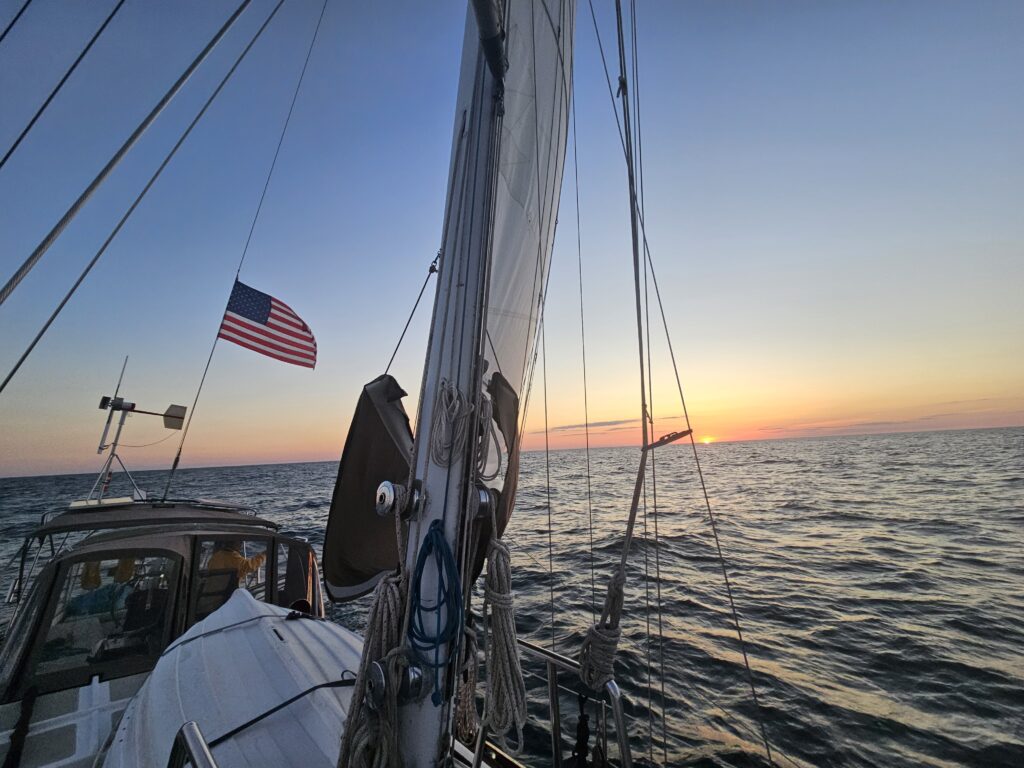
Our trip from Cape May to Block Island is a beautiful one, with winds over the quarter (we did have to motor/motorsail some on Thursday due to light air) the entire journey. At first, seas are too large for the wind so it is rolly, but that lays down after a few hours and then, with Monty (the Monitor vane) steering, we have a peaceful sail. Ship traffic is light, but we see lots of whales in the vicinity of Hudson Canyon. We think they are Fin Whales, maybe some Northern Right Whales, and lots and lots of Atlantic dolphins! And tons of balloons. Angie’s hobby is to cruise over to a balloon (that’s more or less enroute) and pick it out of the water. Perhaps we have saved the lives of some sea turtles. We also see lots of pelagic birds – storm petrels, we later determine, a sea turtle, and a 6 foot-long shark (probably a basking shark) lazily swimming along the surface, its dorsal and caudal fins out of the water.
We had some light air along the way, so our speed dropped below 5 knots for most of Wednesday evening. Thus, as we approach Block Island, we have a new challenge – that of timing slack-before-flood so we can have a smooth entry into Block Island Sound. We cannot make the earlier SBF because of lost time Wednesday night, so we need to slow the boat down to less than 4 knots and make the next SBF. We do so, but are not wholly successful, and arrive at the end of the ebb. We decide to go for it, and the price we pay is enduring big, sloppy, lumpy, disorganized seas (thanks to wind-against-current) as we approach Block Island. But we’re ready to get on in and sleep, so we hang on and push through. We tie up to a mooring at 0500 Friday morning.
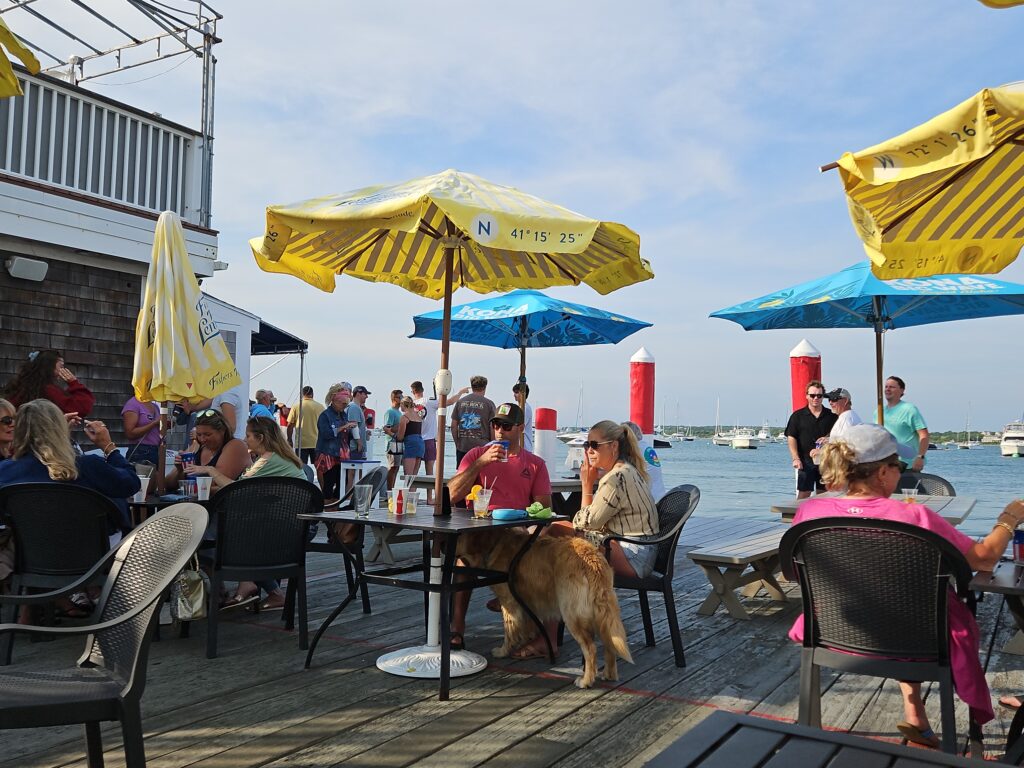
We venture out on Saturday after a proper lie-in. We row at first to Cormorant Cove Park in joyful anticipation that, there, we can land our dinghy on a nice sandy beach, walk up to a park, gain access to a road, and walk into town. But no – there’s no path from the water to the park, and the “beach” apparently is just rocks. So, we row all the way back, past Canto, and to Trader Vic’s where we’ve heard the Mudslides are awesome. And, indeed, they really are! We laze the afternoon away people-watching, drinking our Mudslides (one each) and listening to live Reggae music!
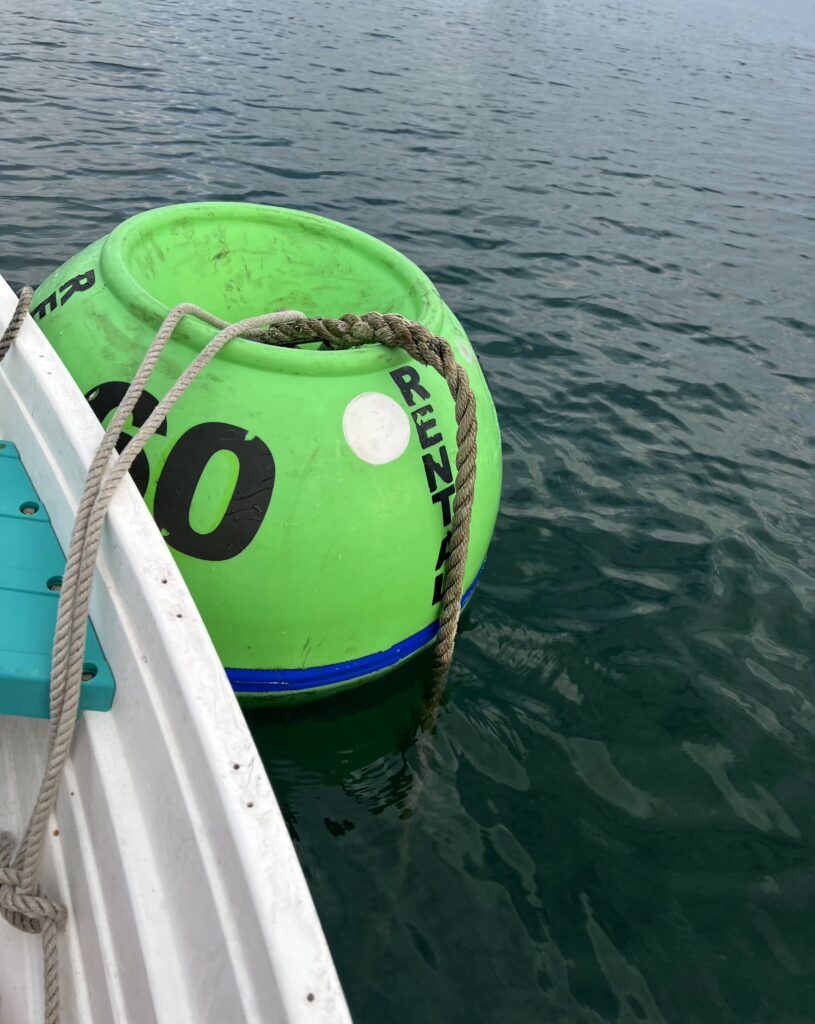
A note about Block Island. It’s best to arrive mid-week, away from any holidays. The lime green and orange buoys here (the rental buoys) are all-day buoys. If you miss one of those, you get assigned a private mooring, but the caveats are: 1). You cannot request one until 2pm. 2). You have to be off of it by 10am. 3) You are not allowed to pick up any old mooring yourself. Seemingly, the option is to just circle around like sharks between 10 and 2, either that or anchor in 25 feet of water. If you want to hop onto a rental mooring, it’s best to be up and at it at daybreak, but be prepared to jostle with other, like-minded boaters. Angie was lucky enough to chat-up a fellow on a Crealock as she rowed past his boat; he told her to show up at his boat at 6am sharp so we could grab his mooring. This we did. He offered us coffee and his mooring, and we gave him some biscotti and conversation in exchange. It shouldn’t be an issue, though, if you arrive say Tuesday through Thursday, on a non-holiday, when the weather is settled.